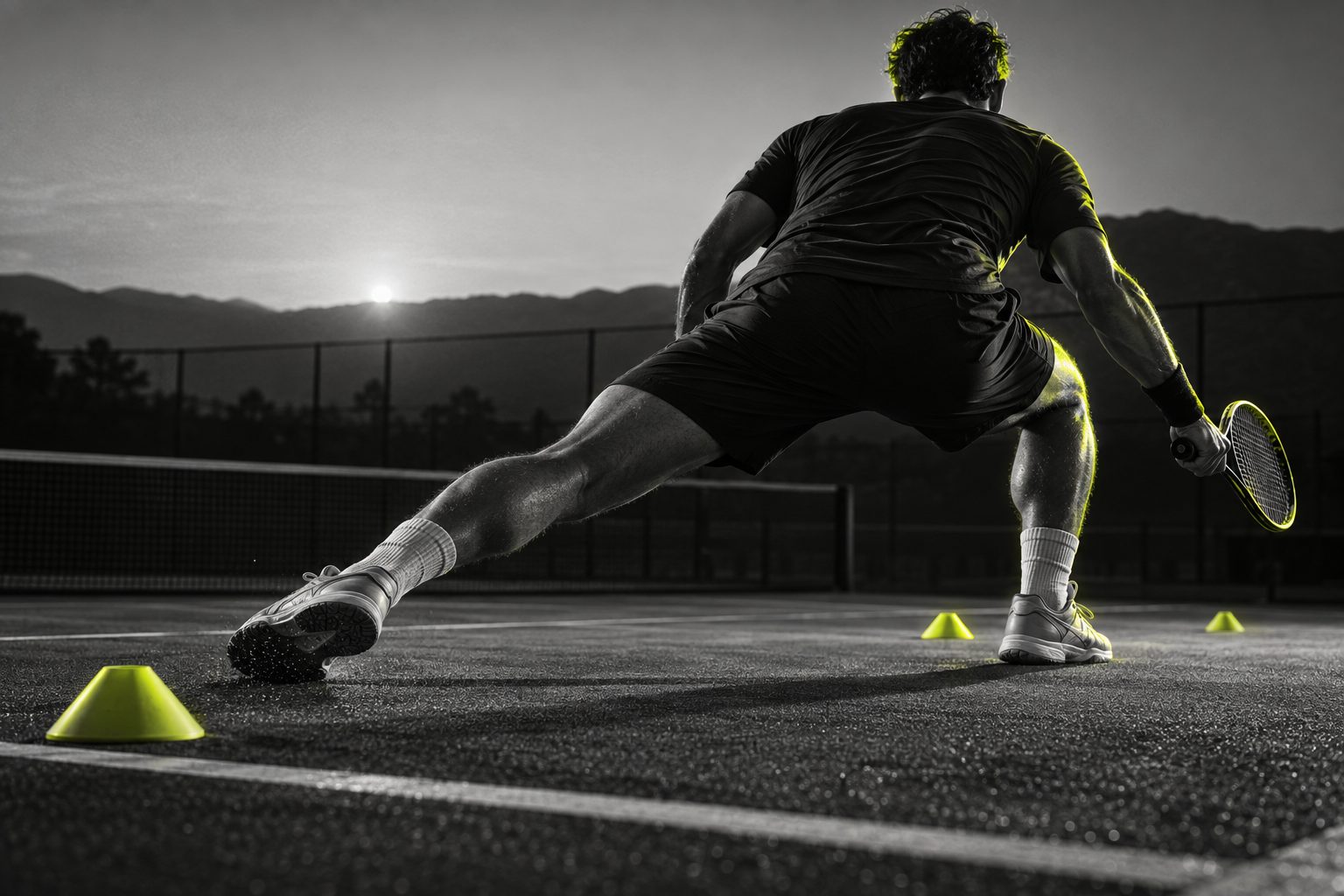
Tennis warm-up, agility and conditioning drills
5 drills77 minutes in all4 you can do alone
- 112 min · Alone
The twelve-minute RAMP
- Raise for 3 minutes: light jog, skips, side shuffles, then mini-tennis.
- Activate and mobilize for 6 minutes: band external rotations, scapular Ws and Ts, glute bridges and dead bugs, then leg swings, lunges with rotation, open books and ankle rockers.
- Potentiate for 3 minutes: accelerations, split steps into sprints, and a handful of progressive serves and groundstrokes.
- Open every session with it, and do your prehab 3–5 times a week.
Why it works · TrainHow to warm up for tennis and recover between matchesNumber to beat4 weeks with every session opened by the full RAMP, no static-stretch opener, and prehab done 3–5 times a week - 220 min · With a partner
The reactive spider
- After warming up and rehearsing the route, use the linked USTA ball-retrieval protocol: collect five balls counterclockwise from right baseline corner, right service-line sideline, T, left service-line sideline and left baseline corner. Return each to a 12-by-18-inch rectangle behind baseline centre; a partner removes it. Time from Ready–Go until the last ball is placed. Rest between three valid trials; your number is the best time, and a wrong route or missed collection is invalid, not a faster result.
- For cued practice, start ready and let your partner call one reachable target before you move. Complete eight attempts, returning under control and resetting before each new call. Count the correct response and controlled arrival separately from elapsed time. The animation’s late-call reversal is an illustration, not the required drill.
- Complete eight manageable, unannounced ball feeds. Hit, recover and prepare for the next strike without forcing a particular crossover or shuffle sequence. Count arrival control and ball-in separately. Stop the block if you cannot keep controlled arrivals; a partial block doesn't count toward the number to beat. The 20 minutes is a session guide, not a deadline for three valid tests and both practice blocks.
Why it works · TrainHow to get faster on the tennis courtNumber to beatBest valid time from 3 trials of the specified ball-retrieval protocol; compare under the same conditions - 315 min · Alone
The 1:2 block
- After a warm-up, sprint sideline to sideline for 10 seconds, touching each line, then walk back for 20 seconds. Do ten reps. Count your touches on the first rep.
- Rest exactly 90 seconds, like a changeover. Do two more sets. Count your touches on the last rep of each set.
- Your number is the touches lost from the first rep to the last. Retest every four weeks.
Why it works · TrainHow to train tennis fitness: intervals, not long runsNumber to beat0 touches lost between your first rep and your last rep - 415 min · Alone
The load ladder
- Hit ten serves from a frozen trophy pose with no knee bend. Note where they land and how your shoulder feels.
- Hit ten serves with a deliberate bend past 90° and a jump. Land on your front foot inside the baseline.
- Hit twenty serves with your full motion. Count the front-foot landings inside the line.
Why it works · StrikeHow to use your legs on the tennis serveNumber to beat16 of 20 front-foot landings inside the baseline - 515 min · Alone or with a partner
The rotational throw ladder
- Throw a medicine ball side-on into a wall or to a partner, hips first, on both sides. Feel the order: legs, hips, trunk, arms.
- Do shotput throws, then overhead throws, in the same order, with full intent and full rest between.
- Finish with ten first serves measured on a radar or ball tracker. Your number is the median speed.
- Repeat the serve test on the same device six weeks later.
Why it works · TrainWhich gym training makes your tennis serve fasterNumber to beatBeat your median first-serve speed from ten serves, six weeks apart