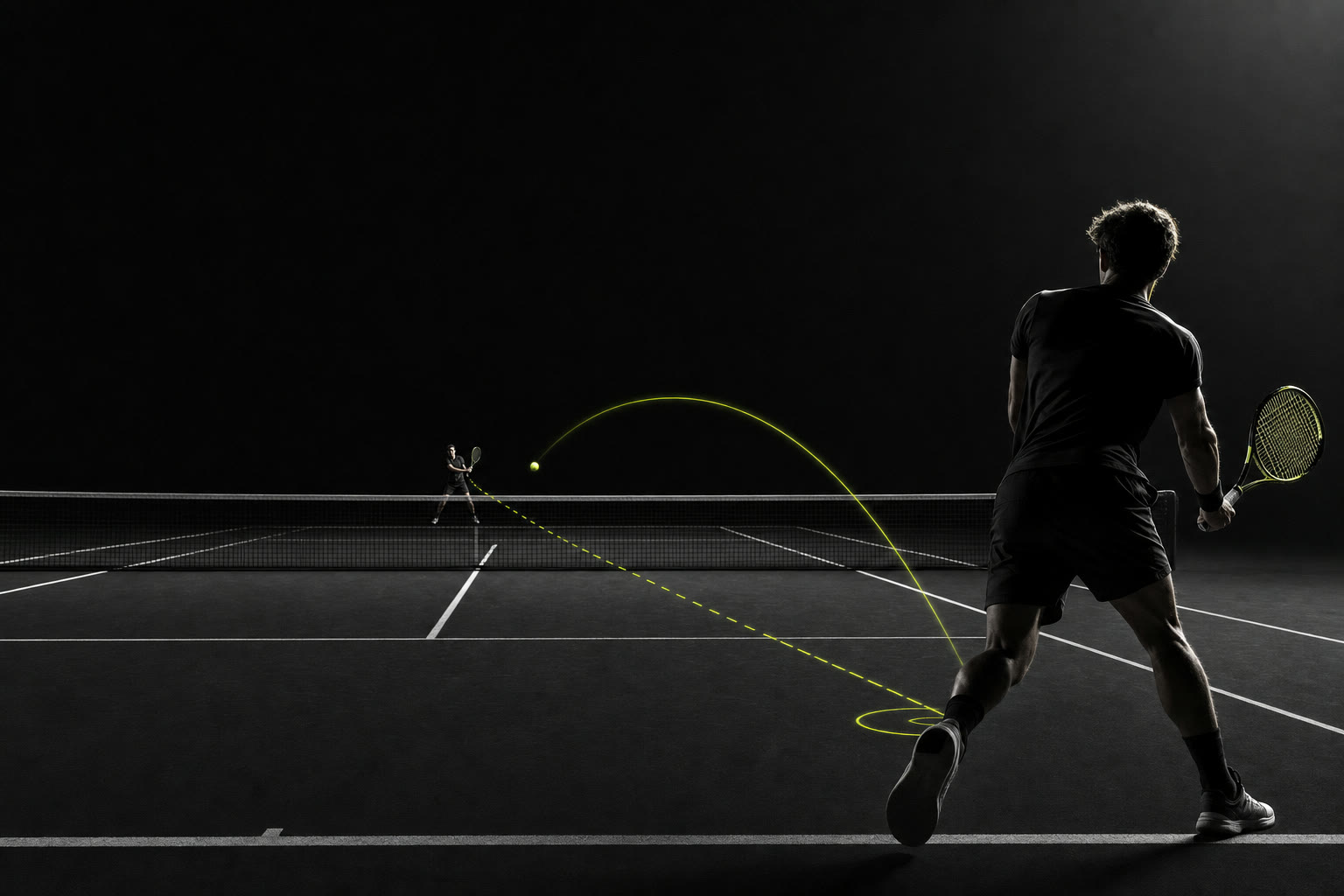
See the point the way a pro plays it.Then go play yours differently.
One real point, Alcaraz serving for Wimbledon, stopped at the seven moments that decided it. Each moment is a secret the pros don't say out loud, measured on the film, and a drill you can run this week, alone or with a partner, at your level.
What loses you matches?
Your answer puts your moment first and sets every drill at your level. Nothing leaves this browser.
Watch it once. Then watch what they saw.
First the point as television shows it. Then the same point with Pro's Eye: what the players were reading, drawn on the film from the tracking. It stops seven times, and three times it asks for your call.
YouTube, Wimbledon (official), Alcaraz v Djokovic, 2023 final, full match (broadcast wide camera) · Fifth set, Alcaraz serving for the title at 5–4, 15–15 · players tracked frame by frame through the court geometry; bounces placed by hand. Footage used for review; licence to follow.
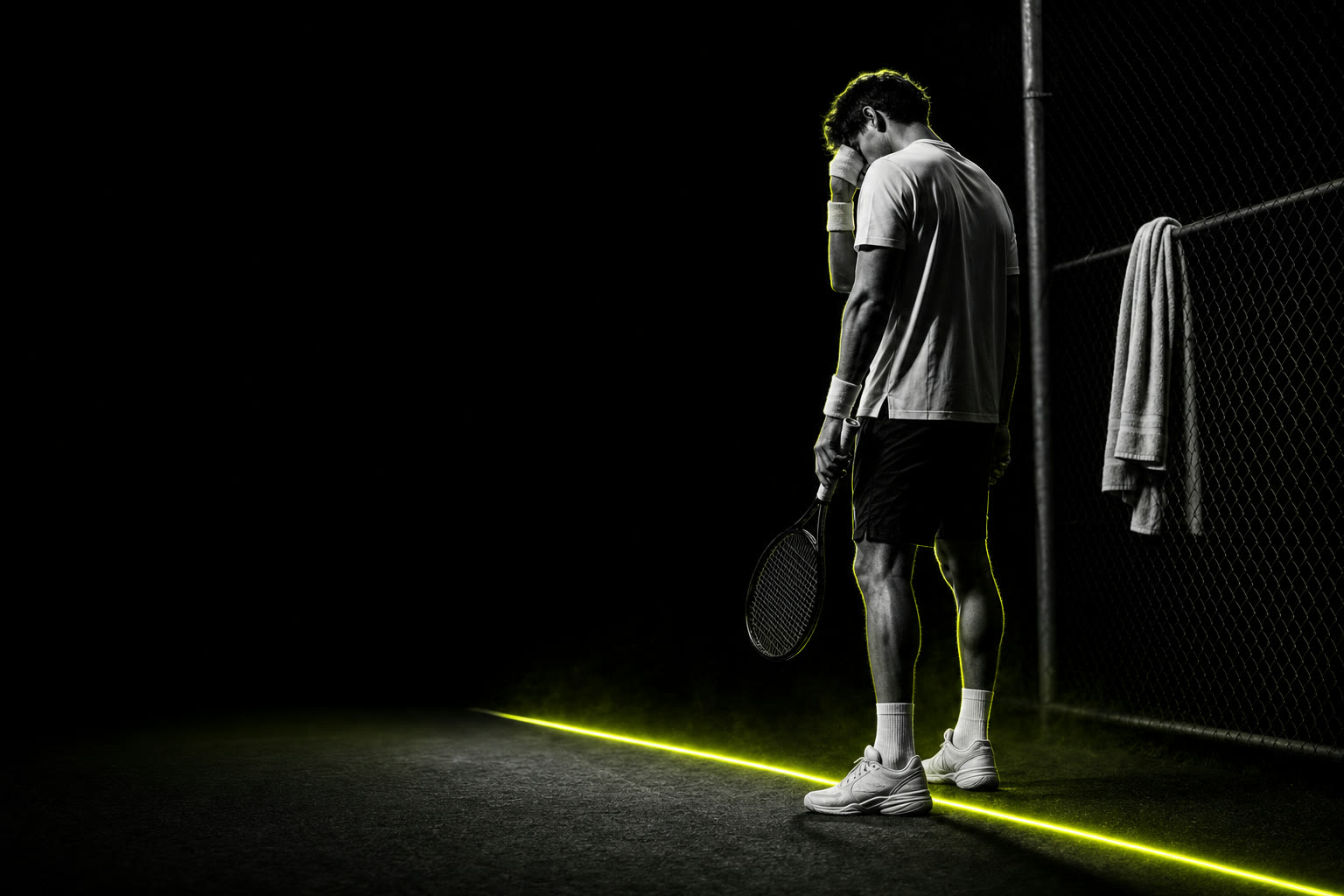
The point starts before the toss
Between serves the pros take about 21 seconds; the clock gives them 25 from the umpire's call. The best spend it on the same four-part routine every point: Jim Loehr's "16-second cure". The boredom you see on television is a reset with a structure you can copy.
Alcaraz at 5–4, 15–15, serving for Wimbledon: the same bounces, the same look at the target, the same toss. The biggest point of his life, the same routine.
Play a set. Your partner counts the points where you ran all four phases before the toss.
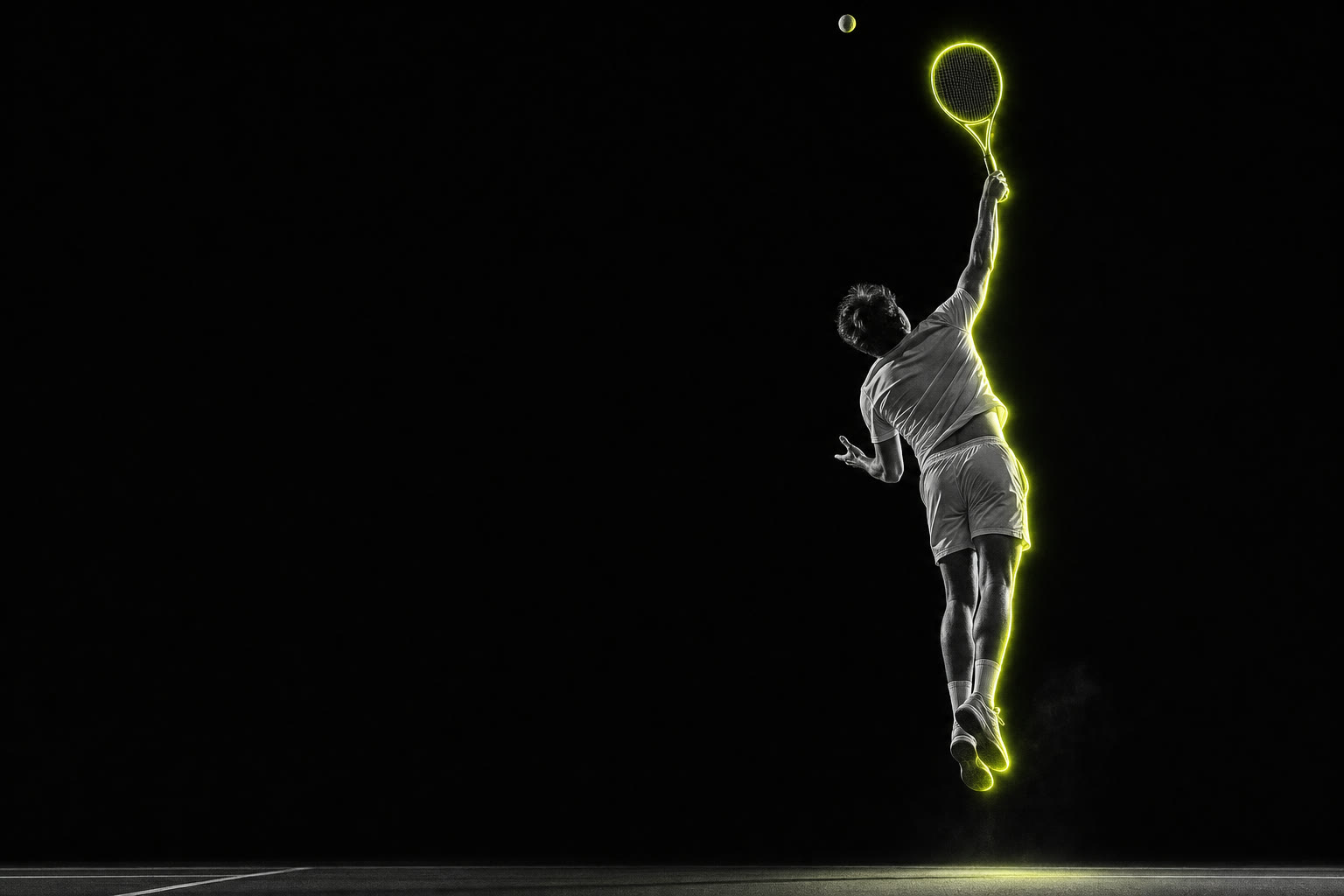
The arm is last
A serve is thrown from the ground up. Legs, hips and trunk supply about half its energy. Of what the arm adds, the shoulder's internal rotation is the biggest share, about 40 %; the forearm's turn adds about 5 %. The arm is the last link, and it only works if everything below it fired first.
Serve, wide, for the title. The chain fires legs → hips → trunk → shoulder → racquet; each link peaks after the one below it.
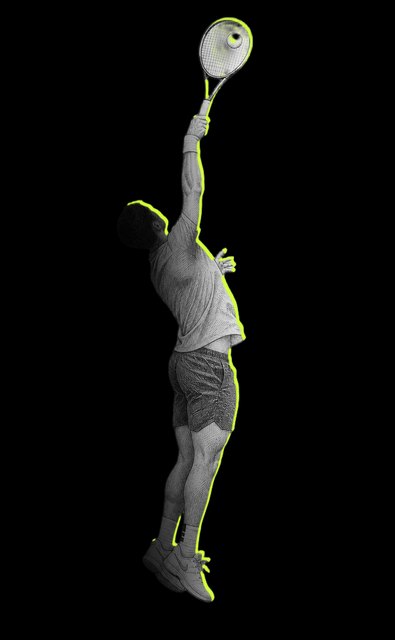
Each link peaks just after the one below it and passes the speed up. The racquet, last, gets the sum. The figure is a traced tour serve; the curves are drawn for illustration. Legs, hips and trunk: about 51 % of the energy (Kibler 1995). Of the arm's share of racquet speed: internal rotation about 40 %, pronation about 5 % (Elliott 2006).
Same three sets; your partner watches only one thing: do you land on the front foot, inside the baseline?

You can't wait and react
A 200 km/h serve bounces about 0.4 s after it is struck and reaches a baseline returner at about 0.65–0.7 s. See it, decide, then move, and most of that is gone. So the best returners read the toss, the trunk and the racquet before contact, split-step as the server hits, and take their first step about 0.18 s after contact: at the edge of human reaction, and with no wrong-way moves.
Tracked: Djokovic starts his split about 0.2 s before Alcaraz strikes the serve, so he is landing as the ball leaves. The return comes 0.78 s after Alcaraz's contact.
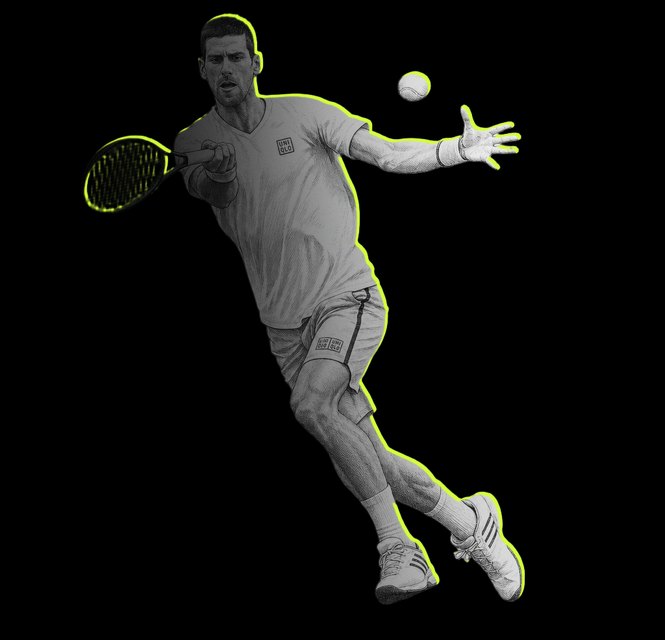
Flight model with drag and spin; the bounce keeps about 70 % of the horizontal speed. Simple reaction is about 200 ms. The expert split lands about 133 ms after the server's contact and the first step comes at about 177 ms (Navia et al. 2022): possible only because the read started before contact.
Real serves from the returner's end. Each one freezes as the racquet meets the ball. Call it before you think.
Serves from the 2023 Wimbledon final, filmed from the returner's end and cut at the server's contact; directions from the Match Charting Project. Four wide, three body, three down the T: guessing won't carry you.
Partner serves at three-quarter pace. Land your split as their racquet meets the ball; call T, body or wide out loud before contact.
The shot after the serve wins
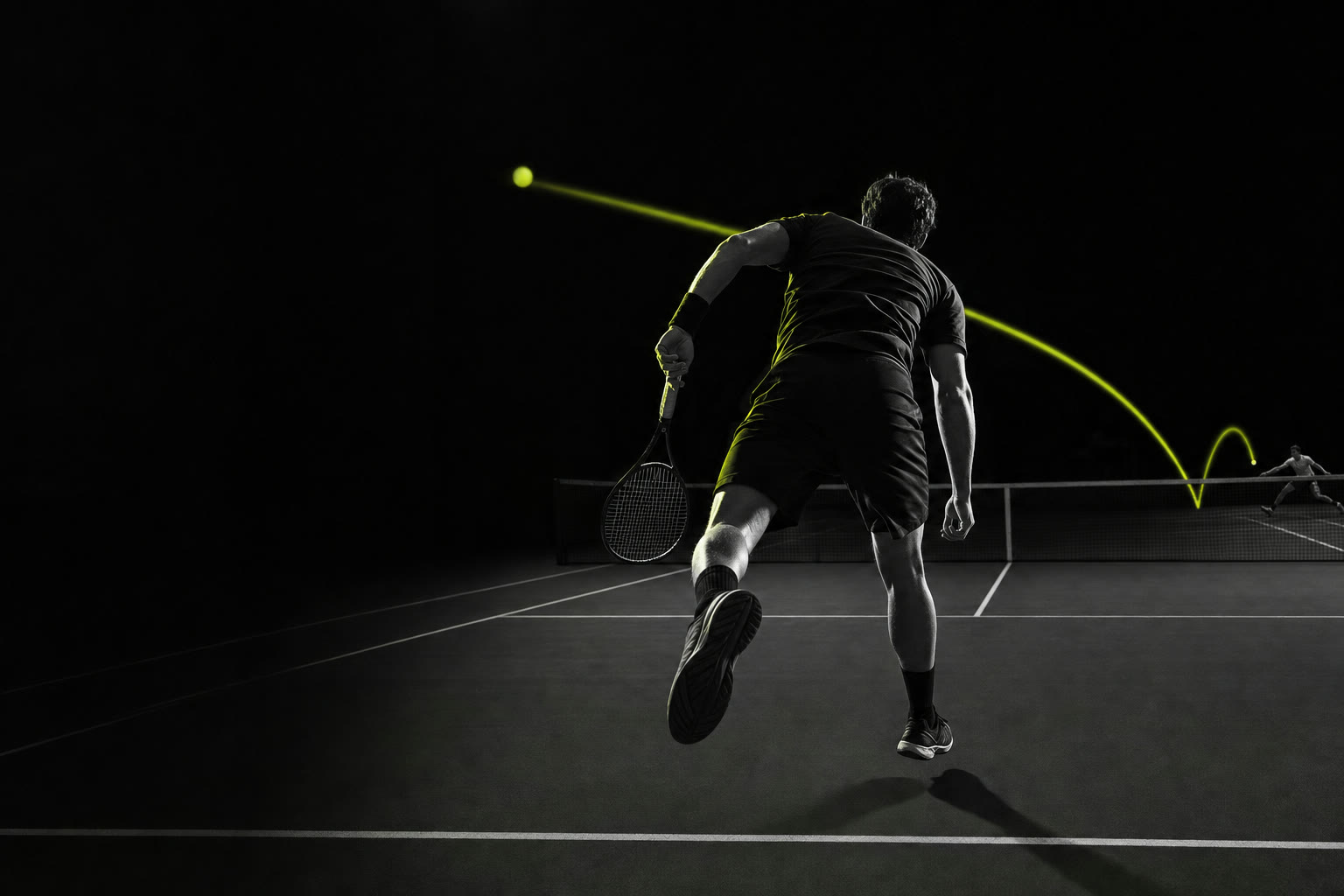
The serve is the only shot you fully control, so pros use it to make the reply predictable, then hit the ball they already planned. The winner you remember was usually set up by ball 3.
The wide serve pulls Djokovic off the court; his return comes back through the middle. Alcaraz's ball 3 goes inside-out into the space on the other side, and he follows it in.
Wide drags the returner off the court. Their reply comes from out there, and the whole other side is yours for ball 3.
Drawn geometry on a deuce-court serve: target, where the returner ends up, the cone they can reply into, and the open court ball 3 goes to. Alcaraz served wide on the point above, serving for the title.
The reply cone and the open court are drawn on the film and the map above: flip Pro's Eye at moment 4.
Serve wide; your partner feeds the short cross reply; hit ball 3 into the open court. Then play it live, first to seven.
Spin buys margin
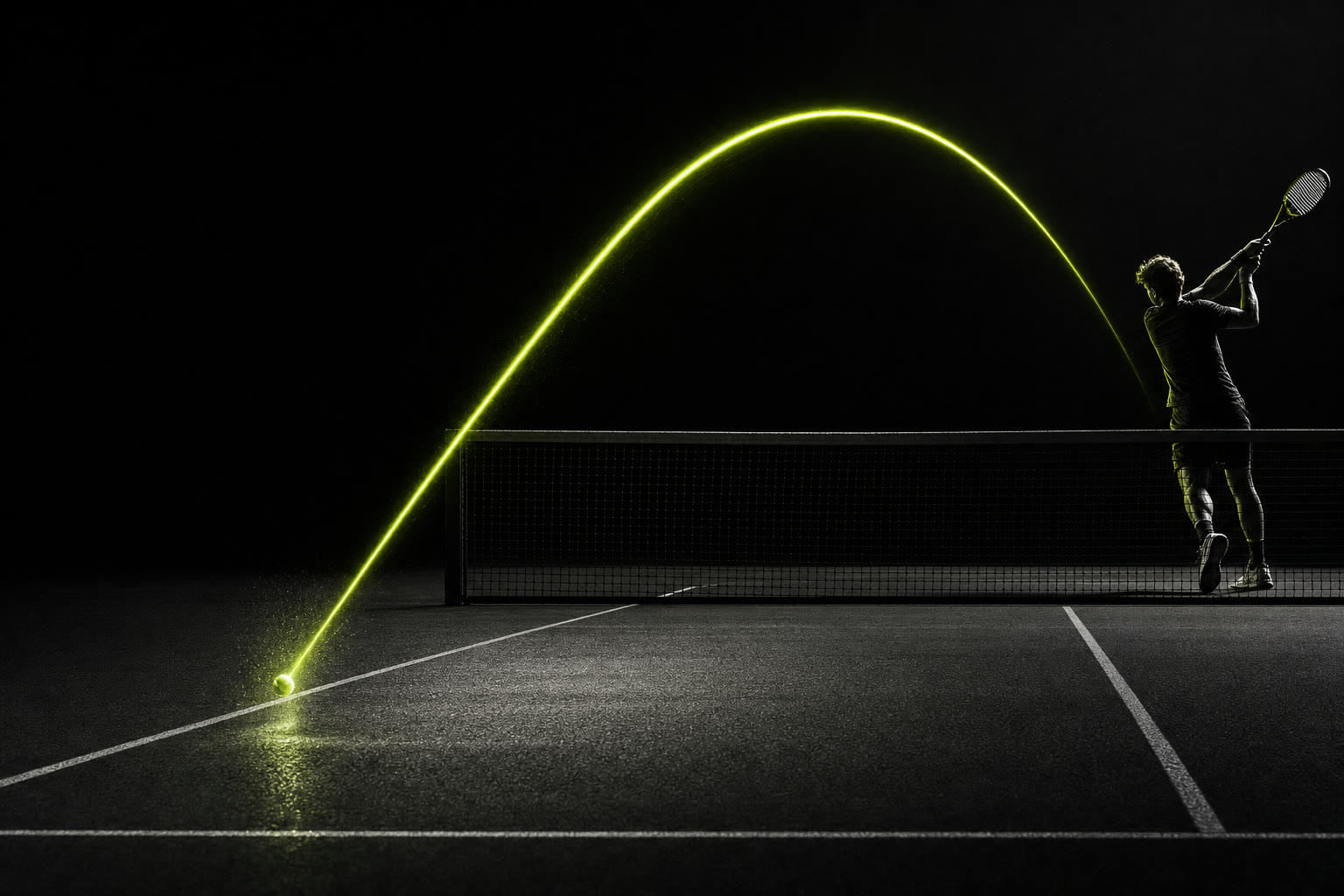
Every ball has to thread a window between the net and the baseline. Topspin bends the ball down, so the window of launch angles that lands in gets wider. The pros don't aim better. They have more room to miss.
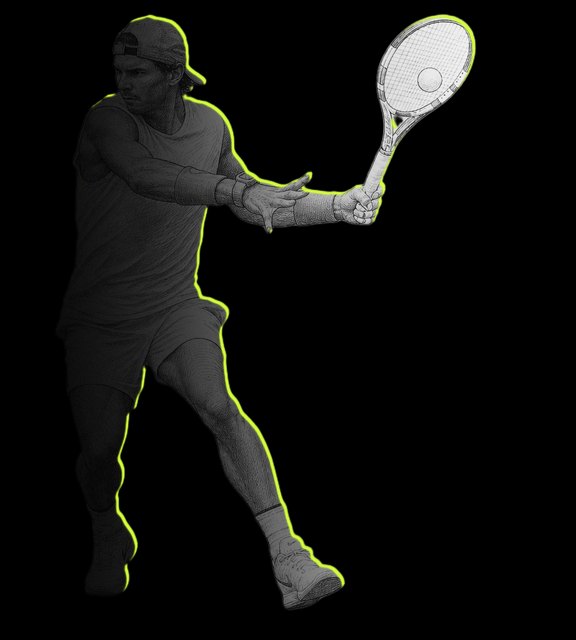
Djokovic's passing backhand has to dip below the net-rusher's racquet and still land in: the smallest window in tennis, and the reason the pass needs spin.
One ball at 25 m/s from 1 m high: the two volt paths are the lowest and highest launch that clear the net and land in. Grey is the flat ball's window. Nadal's forehand was measured near 3,200 rpm; in 2024 Hawk-Eye had Alcaraz at 3,208, Sinner at 3,049 and the tour average at 2,708.
Hang a rope 1 m above the net. Rally forehands over the rope that land inside the baseline. Count twenty.
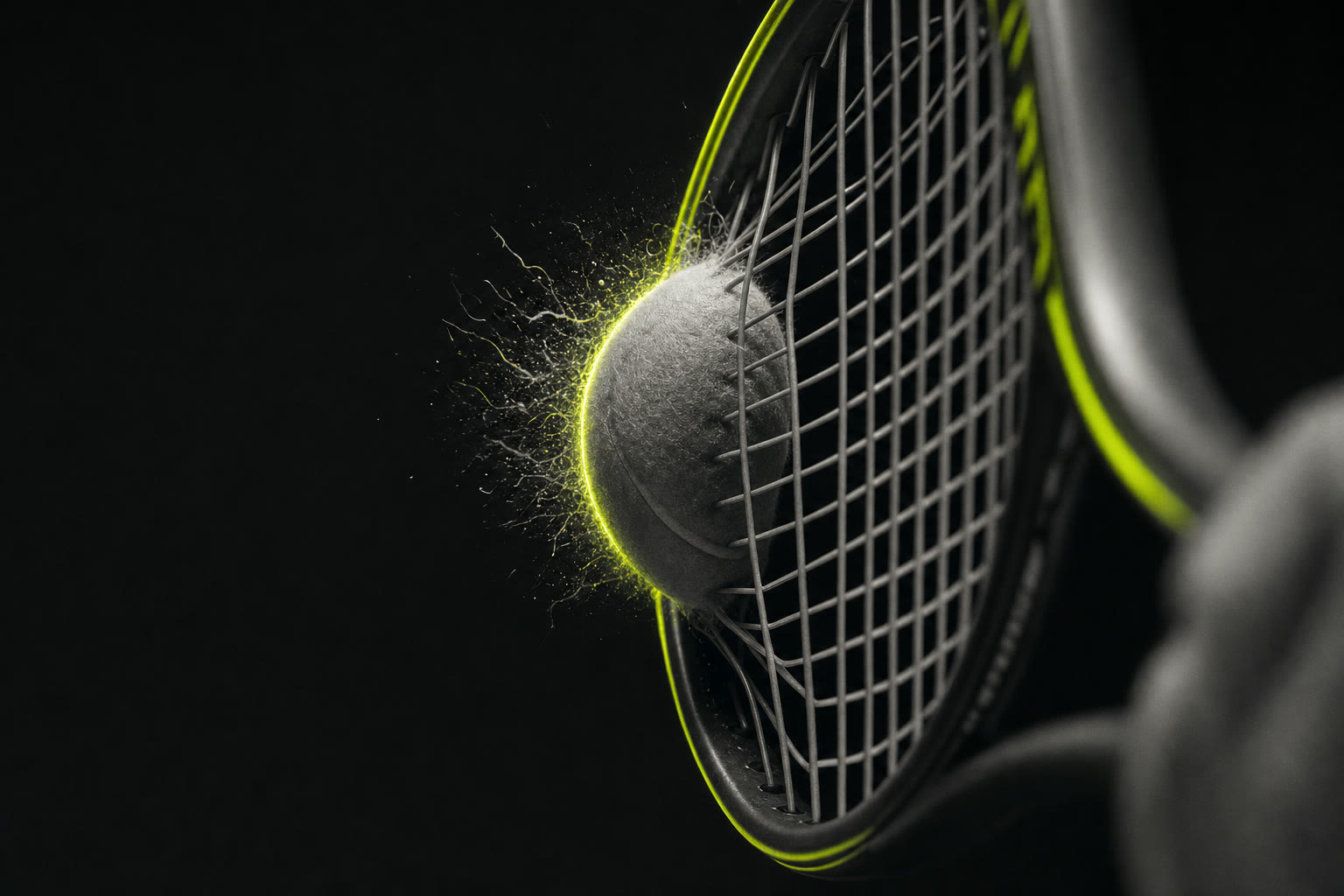
Four milliseconds
The ball is on the strings for about four to five thousandths of a second, and it is gone before the shock even reaches your hand. You can't see it, feel it or steer it. Everything you "do at contact" was decided before the ball arrived, so a timing problem is a spacing problem, and spacing is feet.
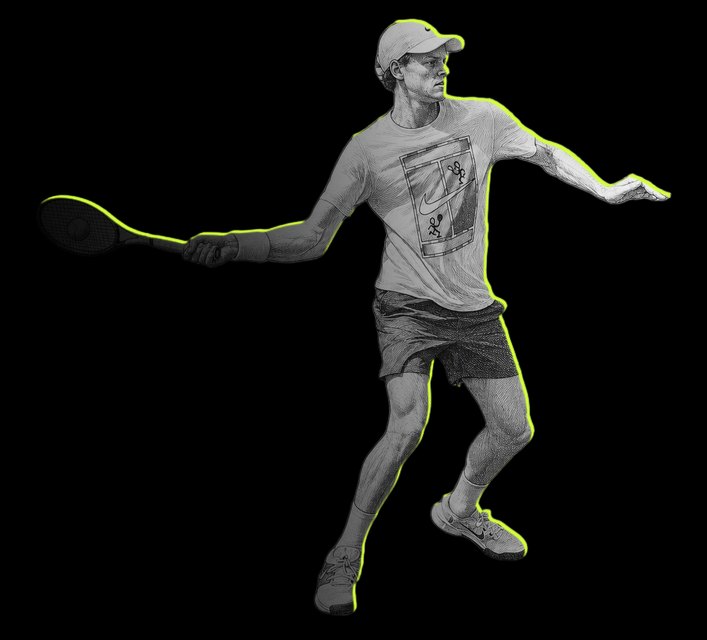
Alcaraz's ball 3 forehand: set early in the middle of the court, contact out in front, weight going forward. The approach was decided before the return bounced.
A drawn model of the dwell (Brody, Cross & Lindsey): compression, the mains sliding and snapping back, the ball leaving faster and spinning. Your brain needs about 200 ms to change anything, so every correction happens before the ball arrives: in your feet.
Partner feeds to alternating depths. Adjust with small steps; freeze on every fifth ball.
Recover to their options
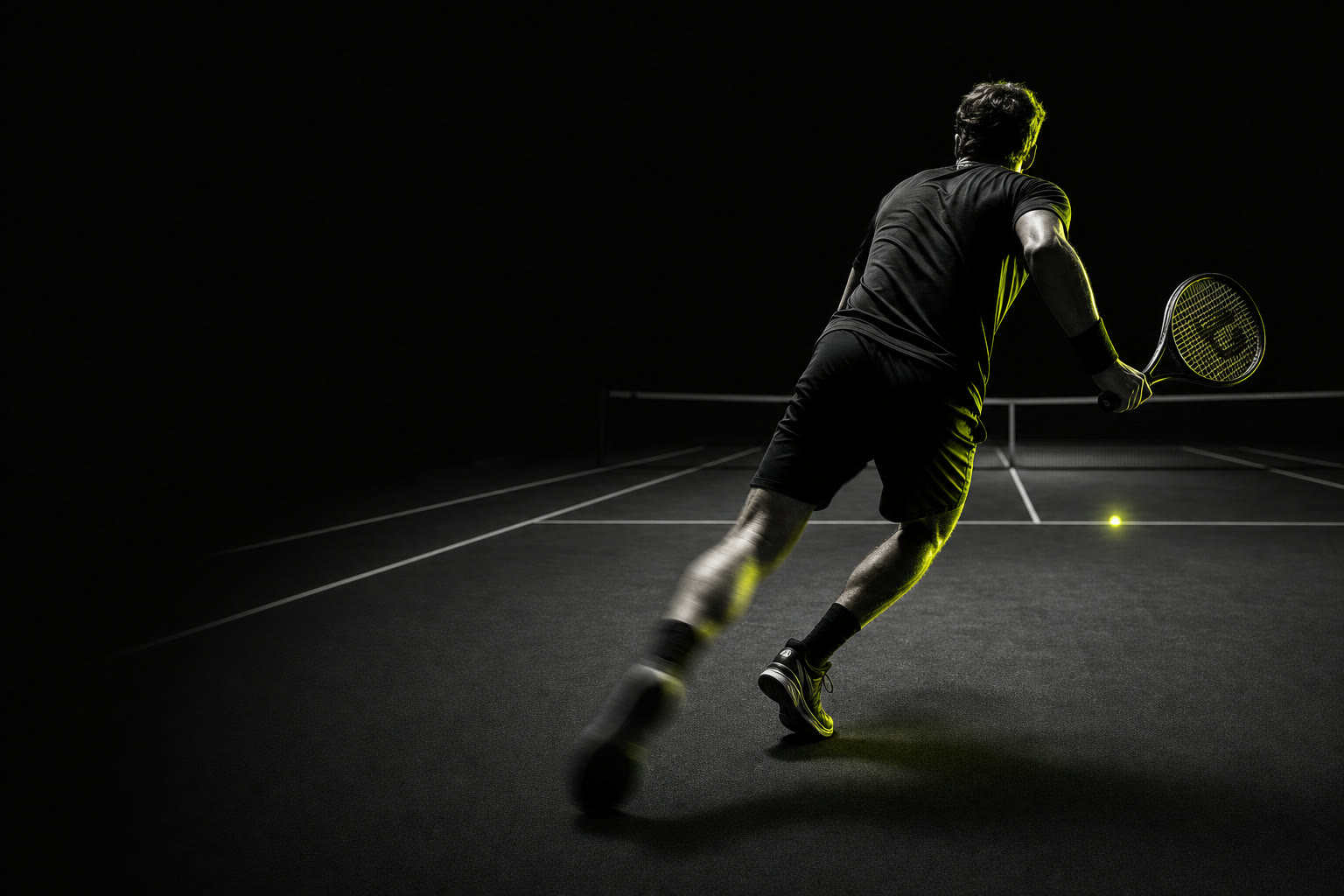
After you hit, don't go back to the middle of the court. Go to the middle of your opponent's options: the bisector of the angle they can hit into. The line sits a metre or more off the centre mark, toward the angle. Across 5,679 rallies at Queen's, top-100 players stood on average 6 cm from it when the opponent struck the ball. Points are won by the shot that finds the defender off it.
Tracked: when Alcaraz hits ball 3, Djokovic is 4.8 m off the bisector, still coming back from the wide serve. At the volley he is on it, within half a metre, and it doesn't matter: from the net Alcaraz's angles span 15.6 m at his depth.
The two dashed rays are their extreme replies: straight down the line, and the sharpest cross-court angle, which leaves the court at your service line. You belong halfway between them. Drag the hitter wide and watch the dot leave the centre mark, toward the angle. Cochet's rule, 1933.
Cross-court rally. After each shot, touch the cone on the bisector before your partner's contact. Partner counts.
Wimbledon 2015–17 (Fitzpatrick); Sinner's 2024 Australian Open run, 59 % (ATP/Infosys). This one is over at shot five, and it was decided at shot three: the wide serve and the inside-out forehand did the work, the volley just finished it.
Three sessions. One test. Seven days.
The ten-minute test below, then your first-fix card.
The Preview Session: all seven cards, at your level.
Your three cards, mixed: change drill every ten balls.
Watch like a pro: one match on TV, three things.
The test again. Your progress card.
- 0–8Mini-tennis to 11, then kneel, stand, launch.
- 8–20Window drill in a rally; hit and freeze on every fifth ball.
- 20–35Return: land the split on contact, call the side before the ball.
- 35–50Serve wide, ball 3 into the open court, touch the recovery cone. First to seven, switch.
- 50–60Every game starts at 30–40. The reset before every point.
Write down three numbers at the end: window /20, wide serves /10, resets /10. Beat them next time.
- Serve wide, +1 to the open court. Choose ball 3 before the toss.
- Cross, cross, then the line only on a short ball.
- Recover to their options, a step past the centre mark toward your own shot.
- Big-point plan, written before the match: one serve pattern, one return plan.
- The reset at every 30–30 and beyond: release, relax, prepare, ritual.
From plays 10.3, 10.4, 09.3, 11.1 and 11.2.
Real serves from the returner's end. Each one freezes as the racquet meets the ball. Call it before you think.
Serves from the 2023 Wimbledon final, filmed from the returner's end and cut at the server's contact; directions from the Match Charting Project. Four wide, three body, three down the T: guessing won't carry you.
Three cones behind your baseline: deuce, middle, ad, each on the bisector for a ball hit from that side. Phone on the fence. On each call, shadow a forehand and recover to the matching cone before the next call.
count the cones you reached
The 25-second reset timer lives with moment 1. Run it on your phone between points of any practice set.
Open the reset timer- The returner's feet at the server's toss, not the ball. When do they move?
- Count to four on every point. Note where it ends. Most end by then.
- Rewind the winner in your head: name the shot that created the opening.
Five numbers today. The same five on day 7.
A basket, two cones, a rope and a phone. Same conditions both days.
| Test | How | Day 1 | Day 7 |
|---|---|---|---|
| Window | 20 forehands over a rope 1 m above the net (or a wall line) | ||
| Wide serve | 10 first serves at a cone in the wide corner of the deuce box | ||
| Contact | 10 forehands filmed side-on: how many in front of the lead hip | ||
| Read | 10 serves from a partner called before the bounce, or one round of the Read the serve trainer | ||
| Recovery | 10 shadowed shots with the recovery caller: cones reached in time |
Enter day 1 now. Come back on day 7: the numbers stay in this browser.
The package has all 87, the whole way down.
Every play is a film room, the instruments, the mechanism and a drill with a number to beat. The seven you just met go deepest on the moment they came from.