How to hit a one-handed backhand, and handle the high ball
Take the one-hander early. Refuse the high ball.
See it, eight instants at a time.
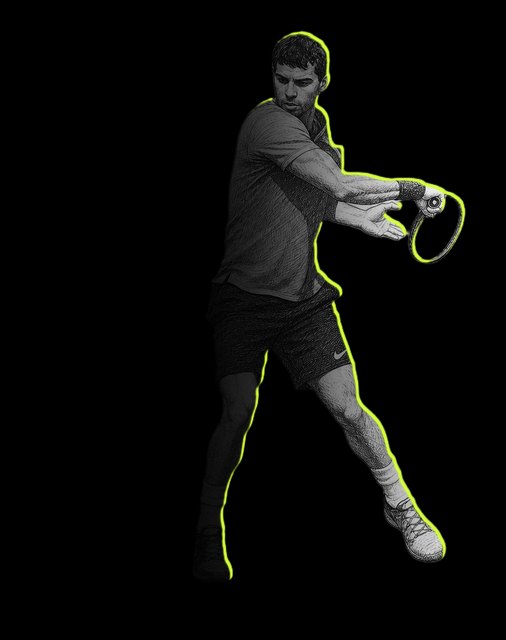
Every frame is traced from real match footage, so you see the shape of the stroke, not a drawing of an idea.
Key facts
- 1
In lab testing, one- and two-handed backhands showed no significant difference in ball speed or accuracy. The one-hander used more forearm speed, the two-hander more trunk rotation.
Kinematics study of one- and two-handed backhands (PMC3588639)
- 2
For a stretch in February and March 2024, no player in the ATP top 10 hit a one-handed backhand, the first time in 50 years.
Berkeley Sports Analytics Group; Tennis Abstract
- 3
Around 8 of the ATP top 100 still hit a one-handed backhand in 2024.
Berkeley Sports Analytics Group; Tennis Abstract
- 4
About 16 of the 32 Roland Garros third-rounders are reported to have hit one-handed backhands in 2000 and 2002, a figure still being checked against its source.
- 5
The one-hander's comfortable strike zone runs from hip to chest, and it's usually hit with an eastern backhand grip, base knuckle on bevel 1.
Why it works
One arm is a long, light lever with no second hand to brace the face. So the one-hander needs two things the two-hander can skip: a deeper turn, and contact well ahead of the front foot, where the arm is straight and the racquet is still speeding up.
Your forehand's out-front isn't far enough. The one-hander's contact is further forward again, because the hitting arm is on the far side of your body. The two-hander meets the ball later and higher, with bent elbows.
The off arm pulls back as the hitting arm extends. That keeps your chest closed. Open early and the ball goes cross-court whether you meant it to or not.
Above the shoulder, the one-hander runs out of leverage. The topspin era produces that high ball on demand, which is why the stroke is disappearing, not because it's slower or less accurate.
The line to say on court“A stride in front, chest closed.”
Drill: The early-contact ladder
15 min · with a partner- Place a cone a stride ahead of your front foot. Have your partner drop-feed ten balls at waist height, and make contact level with the cone, arm straight.
- Take ten feeds at chest height, meeting them at the same cone.
- Take ten feeds that will bounce above your shoulder. Call "rise" or "slice" before the bounce. Score only the calls made in time and hit as called.
More drills like this: backhand
Faults and fixes
Questions players ask
Is a one-handed backhand worse than a two-handed backhand?
Not in the lab. A kinematics study found no significant difference in ball speed or accuracy. Its real weakness is the high ball above the shoulder.
How do you hit a high ball with a one-handed backhand?
Decide before the bounce. Take it on the rise at chest height if you're set, or slice it if you're not. A block is what happens when you decide late.
Where should the contact point be on a one-handed backhand?
About a stride in front of your front foot, further forward than your forehand, with the hitting arm straight.
Why are fewer pros hitting one-handed backhands?
Heavy topspin makes the one-hander's single weakness, the ball above the shoulder, on demand. In early 2024 the ATP top 10 had no one-hander for the first time in 50 years.
What this doesn't cover
The comfort curve for contact height is a model, not a measurement. The decline figures come from different sources and each should be read on its own. This page doesn't settle whether a junior should learn a one-hander. That's a question for a coach who knows the player.
Sources
- Trunk and upper-extremity kinematics in one- and two-handed backhands (PMC3588639)
- Berkeley Sports Analytics Group, "One-Handed Backhands: Endangered but not Extinct"
- Tennis Abstract, ATP one-handed backhand rankings