Why you hit the ball late in tennis, and how to fix it
Meet it in front. Fix your timing with your feet.
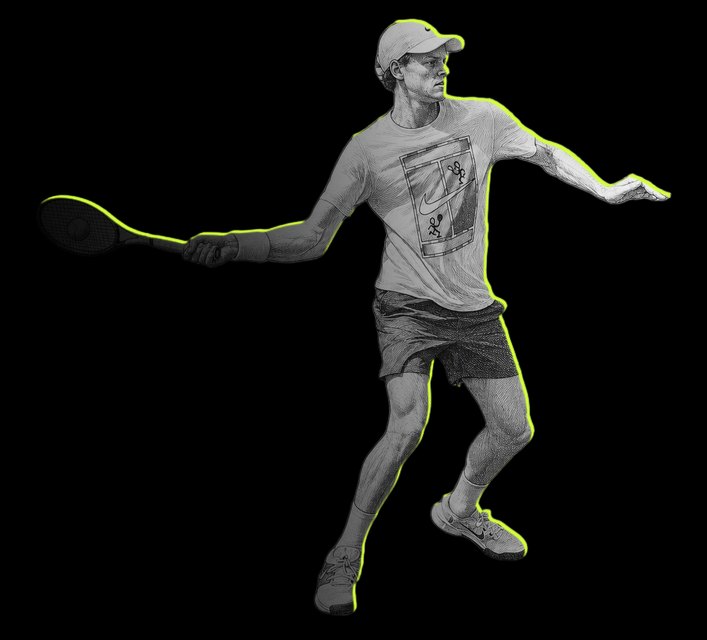
See it, eight instants at a time.
Every frame is traced from real match footage, so you see the shape of the stroke, not a drawing of an idea.
Key facts
- 1
A tennis ball stays on the strings for about 4 to 5 milliseconds, and less with stiffer string beds and frames.
- 2
During that contact the racquet travels roughly 2.5 inches of arc at a swing speed of 40 to 50 mph.
- 3
Ideal forehand contact sits in front of the lead hip, between waist and chest height.
- 4
Late contact is almost always a spacing and footwork failure, not a swing failure.
Why it works
The strings, not the ball, are the spring. The ball squashes and wastes much of its energy deforming. The string bed stretches, stores what it's given and hands most of it back. Your job is to deliver the racquet to the right place at the right speed, in advance.
In front of the lead hip, the racquet is still accelerating, your mass is moving toward the target and the face is easiest to keep square. Meet the ball late and the racquet is already slowing, the face drifts open, and the ball flies long.
So when your forehands start going long, closing the face treats the symptom and swinging slower gives up the shot. The fix is in the half-second before contact: split earlier, take the first step sooner, and use small steps to set your spacing.
The line to say on court“Space first, then swing.”
Drill: Hit and freeze
15 min · alone or with a partner- Hit ten drop-fed forehands. Freeze at contact for a count of one and check, with a partner or a phone, that the racquet is in front of your lead hip.
- Take twenty fed balls to alternating depths. Adjust with small steps and freeze on every fifth ball.
- Film ten rally forehands from the side. Mark the contact frame on each and count how many are in front of your hip.
More drills like this: forehand, practise alone, beginners
Faults and fixes
Questions players ask
How long is the ball on the racquet strings?
About 4 to 5 milliseconds. Stiffer string beds and frames make it shorter.
Can you control the ball during contact?
No. Contact is too short to see, feel or correct. Everything was decided before the ball arrived.
Where should I make contact on a forehand?
In front of the lead hip, between waist and chest height. There the racquet is still accelerating and the face is easiest to keep square.
Why do my forehands keep going long?
Often because you're late. Late contact slows the racquet and opens the face. Get there earlier with your feet rather than closing the face.
What this doesn't cover
Normal video can't show contact. At 240 frames per second, 4 ms is a single frame, so the energy story is a model, not a film. It explains energy, not feel. Exact figures for how much energy the ball and the string bed return vary between sources.
Sources
- Cross & Lindsey, American Journal of Physics 70(5), 2002
- Tennis Warehouse University: string bed energy flow and ball testing
- OnCourtOffCourt: dwell time
- Elliott, British Journal of Sports Medicine