How to hit a two-handed backhand: which hand does the work
Drive it with the top hand. Brace with the bottom.
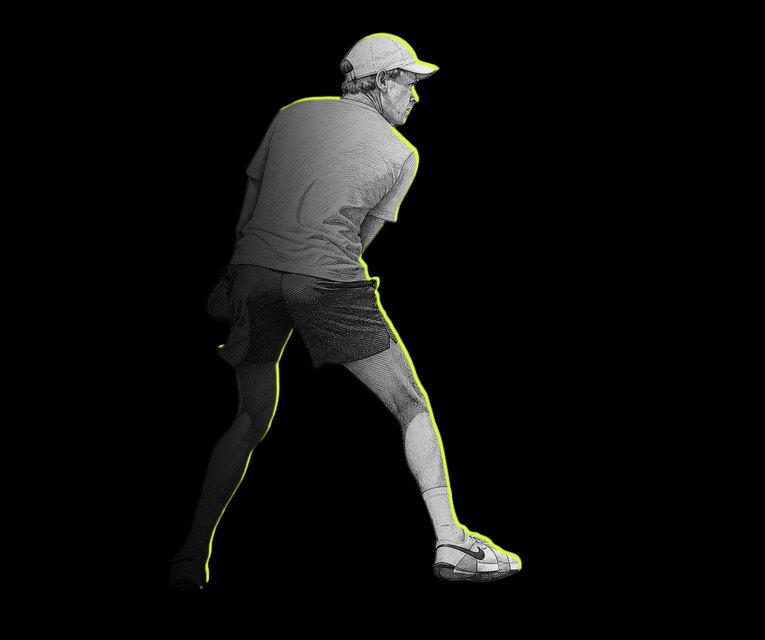
See it, eight instants at a time.
Every frame is traced from real match footage, so you see the shape of the stroke, not a drawing of an idea.
Key facts
- 1
About 92 of the ATP top 100 hit a two-handed backhand.
- 2
The two-handed backhand forms a closed chain with about 8 degrees of freedom.
PMC3588639, trunk and upper-extremity kinematics
- 3
Compared with the one-hander, the two-handed backhand showed significantly greater oblique and trunk activation and faster trunk rotation, but no significant difference in ball speed or accuracy.
PMC3588639, trunk and upper-extremity kinematics
- 4
The two-hander uses a shorter takeback than the one-hander, because two arms can't swing a racquet far behind the body.
Why it works
Two hands make a closed chain. The arms and racquet form a triangle, so the face doesn't get pushed back as the ball rises. That lets you make contact later and higher than a one-hander could survive.
The top hand pushes through like a forehand on the off side, and the bottom hand guides. Many players name the wrong hand. The hand you think is steering is bracing, and your weak hand is doing the hitting.
The engine is the same as a forehand: hips first, trunk on top, contact ahead of the front foot. What differs is the lever, a bent-armed brace instead of one long arm. The takeback is short, and that short takeback is why the two-hander is so strong on the return.
The line to say on court“It's a forehand with your other hand.”
Drill: The other-hand forehand
15 min · with a partner- Hit ten forehands with your non-dominant hand only, eastern grip, low to high. Ugly is fine.
- Hit ten two-handers. Feel the top hand do what it just did alone.
- Take ten feeds at shoulder height. Brace and drive through without backing up.
More drills like this: backhand
Faults and fixes
Questions players ask
Which hand does the work in a two-handed backhand?
In the most common style, the top hand, your non-dominant one, drives through like a forehand while the bottom hand braces. Some players are bottom-hand led, so it varies.
Is a two-handed backhand better than a one-handed backhand?
One study found greater trunk activation and rotation speed with two hands, but no significant difference in ball speed or accuracy. The two-hander's short takeback and braced frame help on high balls and returns.
How do I hit a high ball with a two-handed backhand?
Brace and drive through it without backing up. The two-arm triangle keeps the face from being pushed back as the ball rises.
What should I do on a wide ball with a two-handed backhand?
Get your feet there first. Two hands shorten your reach, so when you're stretched, switch to a slice.
What this doesn't cover
Which hand dominates varies by player, and some are bottom-hand led. The top-hand model here is the dominant school, not a law. Whether the top arm is straighter than the bottom arm at contact hasn't been confirmed on tracked footage.
Sources
- Trunk and upper-extremity kinematics (PMC3588639)
- Segmental momentum transfer in two-handed backhand stances (ScienceDirect S1440244009001728)
- Tennis Abstract: backhands