Pete Sampras's serve
Traced frame by frame from real footage.
Sampras's serve combined pace and spin: first serves averaged 120–125 mph at about 2,700 rpm, where others matched the speed with far less spin. Every first serve came from the same toss and contact point, and the tossing arm stayed fully extended and held.
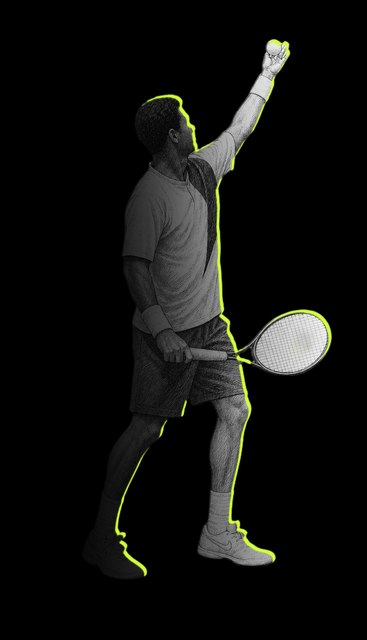
- 1The tossing arm goes up fully extended and stays up, held, while the racquet drops behind his back.
- 2The knees bend deeply as the racquet falls, loading the legs before the drive up.
- 3The ball is still rising above him as he loads: a high toss that gives the motion its time.
Our own observations from the traced frames. Flip through the plate above to check them.
By the numbers
First serves averaged 120–125 mph at about 2,700 rpm (range 2,100–4,260), measured at 250 frames per second in the late 1990s. Henman matched the speed at about 1,500 rpm.
John Yandell, Tennisplayer (Advanced Tennis Research Project)His second serve carried up to about twice the spin of his first.
John Yandell, TennisOneEvery first serve came off the same toss and contact position. The difference between wide and T serves couldn't be seen on 30 fps video.
John Yandell, TennisOne
2002 US Open final
In his last match, he beat Agassi 6–3 6–4 5–7 6–4 for a 14th major, with 33 aces.
Sydney Morning Herald / AFPWhat you can copy
Yandell calls the motion a model for any level. Start with about twice the spin on your second serve, and match your toss height to your own rhythm.
John Yandell, TennisOne
What we don't claim
- Sources give 16 or 17 aces for the 1999 Wimbledon final, so we don't quote a number.