Jannik Sinner's serve
Traced frame by frame from real footage.
Sinner rebuilt his serve in 2023: first the shoulder action, then a pinpoint stance, with Darren Cahill saying they copied John Isner at the start. In 2025 he led the tour in first-serve points won, second-serve points won and service games won, holding 92 % of the time.
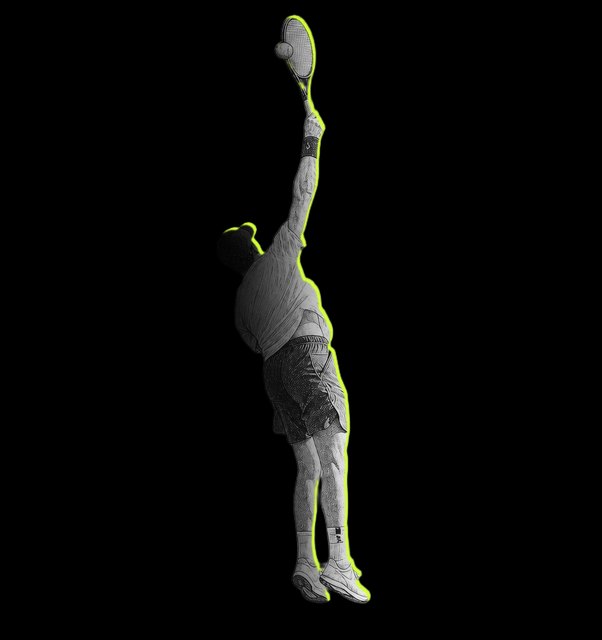
- 1Seen from behind, he starts side-on at the baseline with the racquet low, then tosses as the knees begin to bend.
- 2At the trophy the knees bend deeply, and the back arches as the racquet drops and he drives up off the ground.
- 3Contact is at full stretch with the hitting arm straight up, before the arm turns over and he lands on the front foot, back leg kicked out.
Our own observations from the traced frames. Flip through the plate above to check them.
By the numbers
The 2023 rebuild came in steps: shoulder rotation first, then the step-up to a pinpoint stance, which Sinner asked to do immediately after his 2023 Roland-Garros loss. Cahill said they copied Isner a little at the start.
Darren Cahill on the Served podcast, via Tennishead, Jun 2025From the first half of 2023 to the second: service games won 84 % to 89 %, break points saved 66 % to 75 %.
ATP / Tennis Data Innovations, Nov 2023Career to 2025 to early 2026: first serves in 60.4 %, 61.9 %, 67.5 %. Service games won 86.4 %, 92 %, 94 %. From 2022 his service games won rose from 83.2 %.
ATP Beyond the Numbers, Mar 2026
2025 ATP Finals final
Against Alcaraz, facing set point at 5–6 in the first set, he saved it with a 117 mph second serve, won the tiebreak and the match 7–6 7–5.
ATP, Nov 2025What you can copy
Borrow the order of work: fix the shoulder rotation first, then change the stance. Coaches disagree on pinpoint versus platform for club players, so treat the stance as a choice, not a rule.
Cahill via Tennishead; Nick Wheatley, Tennisplayer
What we don't claim
- He had already served from a pinpoint stance from 2018 to mid-2021, so the 2023 change was a return to it, not a first.