Roger Federer's serve
Traced frame by frame from real footage.
Federer's serve is a simple, classical motion from a platform stance with a continental grip, and its weapon is disguise: wide and T serves look almost identical even on high-speed video. He hit 11,478 career aces, third all-time, and 50 in the 2009 Wimbledon final.
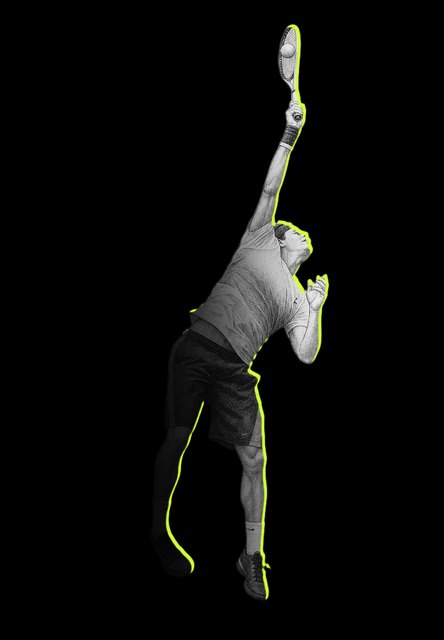
- 1He starts relaxed, racquet hanging, then tosses with the arm fully extended while the racquet swings out to the side.
- 2At the trophy the tossing arm points up and the knees bend. The racquet then drops behind the back as he leaves the ground.
- 3Contact is at full reach, arm and racquet in one line, before the arm turns over and he lands on the front foot with the back leg kicked out.
Our own observations from the traced frames. Flip through the plate above to check them.
By the numbers
Grip: continental or a mild eastern backhand. Yandell suggests a slightly milder continental for less advanced players.
John Yandell, 'Federer's Serve: A Model of Perfection'Between serving wide and down the T, the racquet-angle differences are very hard to see, even in high-speed video.
John Yandell, TennisplayerCareer: 11,478 aces, third all-time, 88.8 % of service games won and 56.83 % of second-serve points won, second only to Nadal.
Roland-Garros.comAt Wimbledon, his average serve speeds were the same in 2003 and 2017, but second-serve points won rose from 51 % to 67 %.
Craig O'Shannessy on Tennishead, 2018
2009 Wimbledon final
He beat Andy Roddick 5–7 7–6 7–6 3–6 16–14 with a career-high 50 aces, a Grand Slam final record, for his 15th major. He broke Roddick only once, in the last game.
ESPN, Jul 2009What you can copy
Yandell calls it a simpler, more classical motion than Sampras's or Roddick's, and a great model for most players at most levels: if you pick one pro serve as a template, pick this one.
John Yandell