Roger Federer's forehand
Traced frame by frame from real footage.
Federer's forehand pairs a fairly conservative grip, between eastern and semi-western, with the big torso and arm rotation of western-grip players. That gives the windshield-wiper finish, about 2,700 rpm of spin and a huge range of shots. His head stays still for about a tenth of a second after contact.
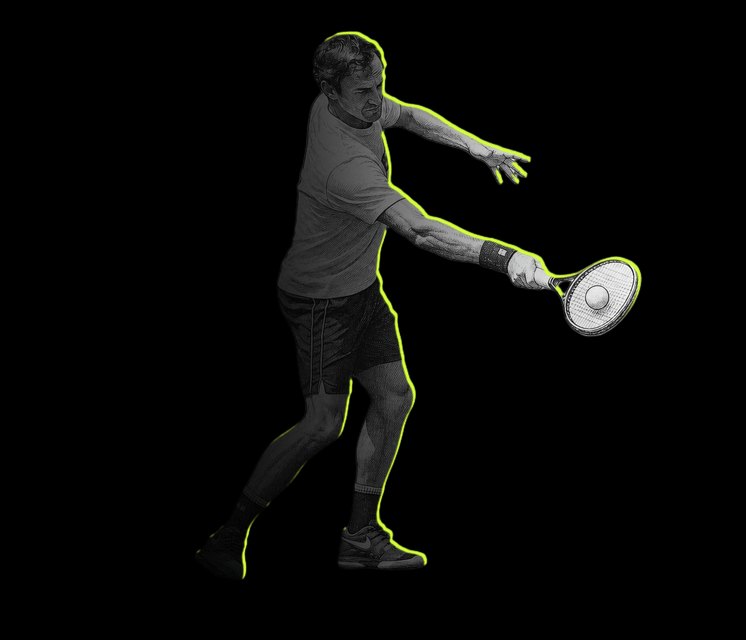
- 1The unit turn starts with the racquet held up in front of the chest, both hands on it, then the shoulders turn with the other hand still on the throat.
- 2The racquet drops low and back while the free arm stretches out toward the ball, then lags below the ball as the body turns forward.
- 3Contact here is on a low ball, out in front with the arm extended, and the finish comes over the opposite shoulder with the chest square to the net.
Our own observations from the traced frames. Flip through the plate above to check them.
By the numbers
High-speed video shows a grip between eastern and semi-western: the heel pad on bevel 3 with the index knuckle toward bevel 4, roughly halfway between Sampras and Agassi.
John Yandell, Tennisplayer; Tennis.com (2009)His head turns to its famous sideways position only a few hundredths of a second before contact, then stays still for about a tenth of a second after the hit, longer than any other player Yandell filmed.
John Yandell, TennisplayerYandell's video counts put his average forehand spin at about 2,700 rpm, against about 3,200 for Nadal.
TIME, Jan 2009In five years of hard-court charting to early 2021, 61.2 % of his rally shots were forehands, against a 55.9 % sample average.
Bill Connelly, ESPN, Feb 2021 (Match Charting Project)
2017 Australian Open final
From 1–3 down in the fifth set against Nadal, Federer won 6–4 3–6 6–1 3–6 6–3. It ended on his second championship point with a forehand winner that Nadal challenged and Hawk-Eye called in.
Australian Open match reportWhat you can copy
His grip suits the waist-high balls most club players face, which makes him a better model than more extreme-grip pros. Use the wiper finish for spin and angle, not on every ball.
Tennis.com (2009)The other side: Pat Cash argues the straight arm leaves a short hitting zone and little margin, and advises most players to use a bent, handshake-style arm instead.
Pat Cash, 2019