Juan Martín del Potro's forehand
Traced frame by frame from real footage.
Del Potro's forehand was a flat, heavy drive built on a big loop and near-full arm extension at contact, measured at up to 120 mph. Coaching analysts describe an eastern grip and less shoulder rotation than similar hitters, with his height and reach adding pace.
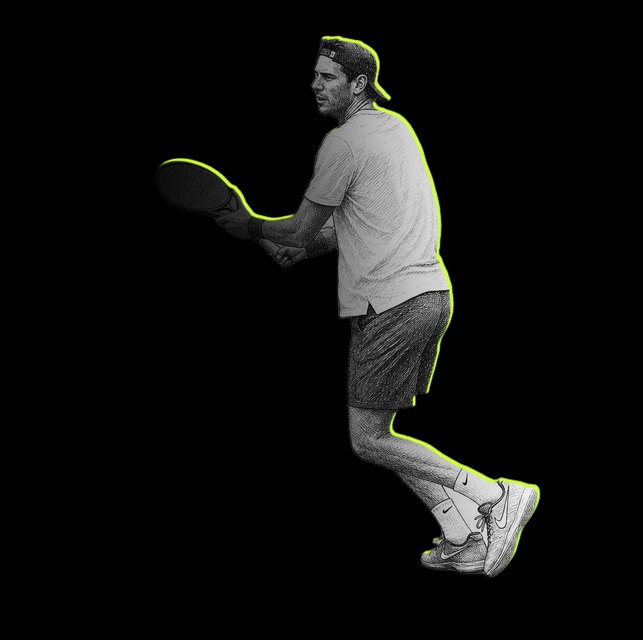
- 1The takeback is a big, high loop, with the racquet raised well above his head.
- 2Through contact the hitting arm is close to fully extended, the shape of a flat drive.
- 3He comes off the ground through the shot, and the finish wraps over the opposite shoulder.
Our own observations from the traced frames. Flip through the plate above to check them.
By the numbers
A 120 mph forehand was measured in 2011.
Jim Fawcette, TennisplayerCoaching analysis describes an eastern grip, an open face on the takeback for a flatter ball, near-full arm extension at contact and less shoulder rotation than Federer, González or Tsonga.
Tactical Tennis, 2017
2009 US Open final
At 20, he beat Federer 3–6 7–6 4–6 7–6 6–2, ending Federer's five-year run in New York, a day after beating Nadal 6–2 6–2 6–2. The BBC's report said Federer paid the price for playing to the forehand too often.
BBC Sport, Sep 2009What you can copy
His height and arm length are part of the pace, which most players can't copy. The analysts who broke it down point to Federer's forehand structure as the better model for variety.
Tactical Tennis
What we don't claim
- A 120 mph forehand often attributed to the 2013 Wimbledon semi-final may have been a serve-speed graphic. We don't use it.