How to hit a half-volley in tennis
Get under the bounce. Lift it, don't flick it.
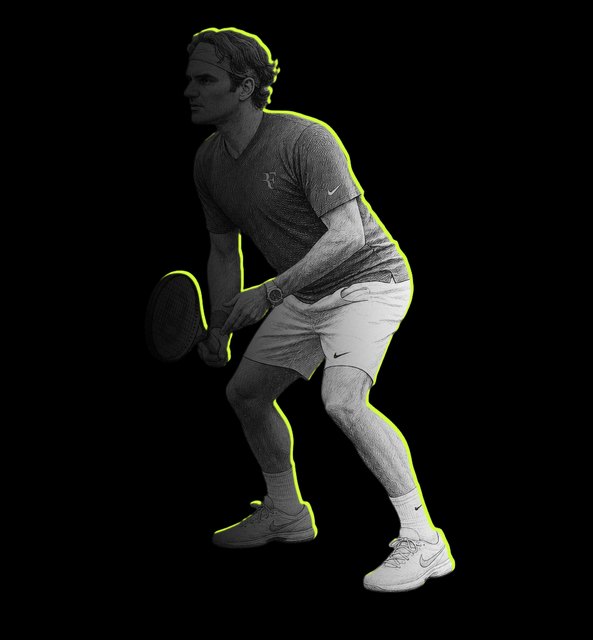
See it, eight instants at a time.
Every frame is traced from real match footage, so you see the shape of the stroke, not a drawing of an idea.
Key facts
- 1
Half-volleys cluster in the approach zone inside the service line, on the ball that lands at your feet as you move in.
- 2
Just after the bounce there's a short window where the ball is low enough to control and high enough to have cleared the court.
- 3
You can't swing at a rising ball at your ankles, so the half-volley is a block with a slightly open face.
- 4
The body opens the window, not the racquet: your hand has to be below the ball's line, and standing tall closes the face.
Why it works
After the bounce the ball is rising fast and close to the ground. There's a short window where it's low enough to control and high enough to have cleared the court. Take it there.
You can't swing at a rising ball at your ankles, so the stroke is a block with a slightly open face. The lift comes from the face angle and the forward step, not from the wrist. The racquet starts in front and the follow-through stays short, like a volley taken much lower.
The body has to be low enough that your hand is below the ball's line. Stand tall and the face closes on its own. That's why the half-volley is a posture decision made before the bounce, and the hands only finish the job. Its point is that it lets you keep coming forward.
The line to say on court“Knees, not wrist.”
Drill: The short-hop ladder
15 min · with a partner- Stand at the service line. Your feeder drops balls at your feet. Hit ten: freeze low before the bounce, block, and lift the ball over the net.
- Hit ten more moving forward from the baseline into the same ball. Count the ones that land past the service line.
- Hit ten more, each followed by closing in and volleying the feeder's next ball.
More drills like this: volley and net
Faults and fixes
Questions players ask
Why do my half-volleys go into the net?
You're standing tall, so the face closes. Drop your hips before the bounce and open the face slightly.
Should I volley or half-volley a ball that's about to land at my feet?
Half-volley it on the move. Stopping to volley means reaching down at a ball that hasn't bounced, and backing up gives away the net you just earned.
Do you swing on a half-volley?
No. Block it with the racquet starting in front and a short follow-through.
What should I do after a half-volley?
Keep coming forward and close to the net for the next ball.
What this doesn't cover
A success rate for the half-volley probably hasn't been measured anywhere, and the width of the timing window hasn't been measured. The bounce behaviour behind the advice is modelled, not measured on each surface.
Sources
- USTA net-play instruction
- Elliott, British Journal of Sports Medicine (2006): lower-body loading in tennis strokes