How to hit a drop shot and a lob with disguise
Show them a drive. Then drop it or lift it.
See it, eight instants at a time.
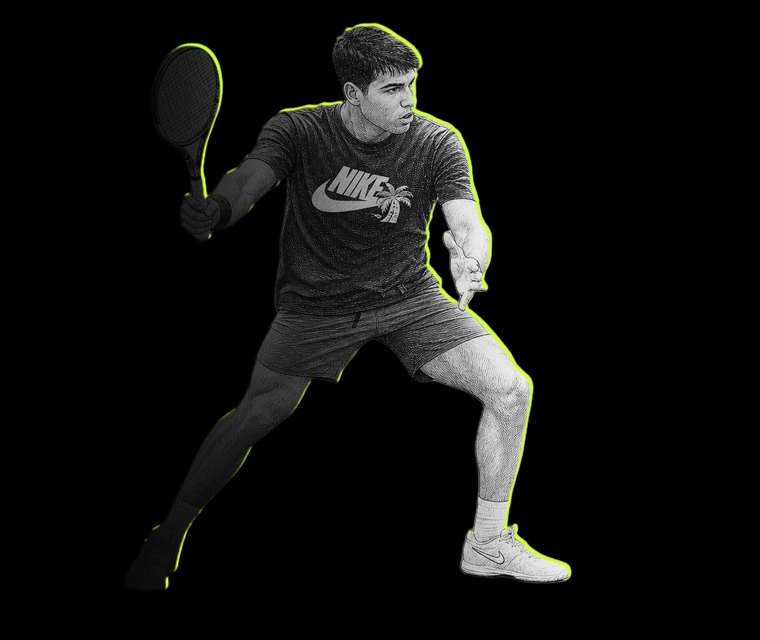
Every frame is traced from real match footage, so you see the shape of the stroke, not a drawing of an idea.
Key facts
- 1
Across more than 4,600 charted men's matches since 2015 and about 35,000 drop shots, the player hitting the drop shot won the point 53.8% of the time.
Jeff Sackmann, Tennis Abstract, March 2024
- 2
Carlos Alcaraz won 62.1% of his drop-shot points, hitting one on about 5.4% of points, fifth of the 60 most-charted players.
Jeff Sackmann, Tennis Abstract, March 2024
- 3
Alcaraz's drop shots gained him about 6.5 points per 1,000.
Jeff Sackmann, Tennis Abstract, March 2024
- 4
After an opponent's drop shot, Alcaraz's next-point win rate was 44.0%, against 40.1% otherwise.
Jeff Sackmann, Tennis Abstract, March 2024
Why it works
The drop shot is half execution, half disguise. It has to look like a drive or a slice until the last instant. Then the hand softens and the face opens, racquet speed at contact drops, and backspin kills the forward momentum. The ball lands short and bounces low and back.
The lob is the same threat aimed the other way. The offensive topspin lob starts like a pass, dips behind the net player and kicks away. The defensive lob is high and deep, often sliced, and its job is to buy time.
A believable threat of each makes the other work. The disguise of the setup is the weapon, not the shot. Drops work best against deep opponents, on clay and against fatigue.
The line to say on court“Same setup, three exits.”
Drill: The guess
15 min · with a partner- Hit ten deep backhand slices with your partner at the baseline. Groove the takeback.
- Hit ten drop shots from the same takeback. Only balls that bounce twice inside the service box count.
- Mix all three: drive, drop and lob. Your partner calls the shot as early as they can. Score the ones they called late or wrong.
More drills like this: point play
Faults and fixes
Questions players ask
When should you hit a drop shot?
Drop shots work best against opponents standing deep, on clay and against a tired player.
Should I lob or pass when my opponent is at the net?
Read their balance. If they're tight to the net, balanced and racquet up, lob over the backhand shoulder. If they're leaning or have left a gap, hit the dipping pass at their feet.
Do drop shots actually win points?
In charted men's matches since 2015, the player hitting the drop shot won 53.8% of those points. Alcaraz won 62.1% of his.
What's the difference between an offensive and a defensive lob?
The offensive topspin lob starts like a pass, dips behind the net player and kicks away. The defensive lob is high and deep, often sliced, and buys you time to recover.
What this doesn't cover
The finding that a drop shot affects the next point is one player's result, not a law. The win rates come from charted men's tour matches, not club play.
Sources
- Jeff Sackmann, "Effects and After-Effects of the Carlos Alcaraz Drop Shot", Tennis Abstract, March 2024
- Jeff Sackmann, "More About Drop Shots: Alexander Bublik Edition", Tennis Abstract
- ATP Tour: "What Shot Has Carlos Alcaraz Popularised?"
- Match Charting Project