Novak Djokovic's return
Traced frame by frame from real footage.
Djokovic's return is short and early: almost no backswing, a push off the outside leg to cut forward, and the server's pace redirected deep through the middle. He had won 31.6 % of career return games entering 2026, first among active players, peaking at 38.8 % in 2011.
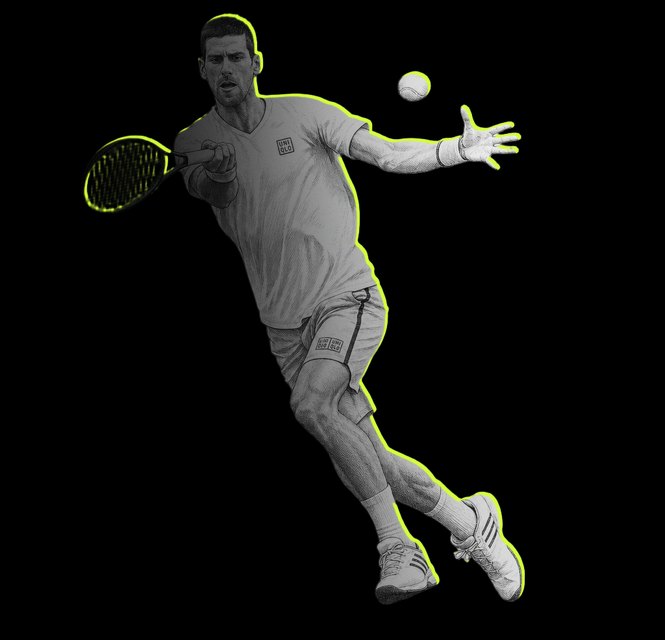
- 1He lands the split on a wide base, weight forward, ready to go either way.
- 2The first move is a long step out toward the ball, and the takeback stays short.
- 3Contact comes in front of the body while he's still stretching, and the finish is compact.
Our own observations from the traced frames. Flip through the plate above to check them.
By the numbers
31.6 % of return games won entering the 2026 Australian Open, seventh best on record and first among active players. He won at least 30 % every season from 2009 to 2021, peaking at 38.8 % in 2011.
ATP Beyond the Numbers, Jan 2026Mouratoglou's breakdown: almost no backswing, just a shoulder turn, a push off the outside leg to cut forward, the serve's pace guided back, and a target deep through the middle.
Tennis Gazette, summarising Patrick Mouratoglou, Mar 2026
2011 US Open semi-final
At 3–5 in the fifth set, facing two match points, Djokovic hit a full-swing cross-court forehand return winner off Federer's wide serve. Djokovic said he read the serve. He won the match and then the title.
Steve Tignor, Tennis.comWhat you can copy
Mouratoglou's four points are general advice any player can use on first-serve returns: a short backswing, a push off the outside leg, use the server's pace, aim deep through the middle.
Tennis Gazette / Mouratoglou