How to return a fast serve: split, read, commit
Land as they hit. Read the toss before the ball.
See it, eight instants at a time.
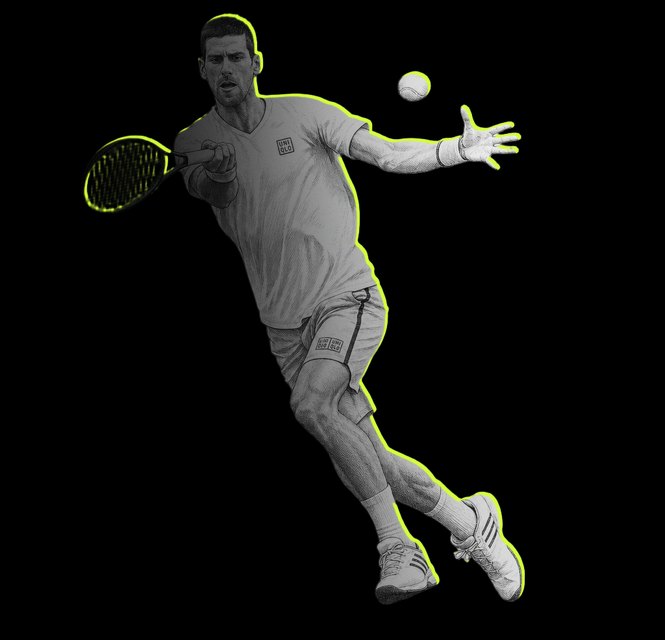
Every frame is traced from real match footage, so you see the shape of the stroke, not a drawing of an idea.
Key facts
- 1
A 200 km/h serve gives the returner about 333 ms from the server's contact to their own.
Farrow, The Conversation
- 2
Human simple reaction time is about 200 ms, which leaves too little time to see, decide and then move on a fast serve.
- 3
In lab video studies, skilled returners predicted serve direction from footage cut off about 300 ms before contact. That's a prediction result, not movement.
Farrow, The Conversation
- 4
On court, 12 expert returners started the split around the server's contact, landed about 133 ms after it and made their first sideways move about 177 ms after it.
Navia et al., Journal of Sports Sciences, 2022
- 5
The main pre-contact cues on a serve are toss location and height, trunk orientation and racquet-face angle.
Farrow; Frontiers in Psychology, 2018
- 6
In world-class returners, split-step timing, not just having a split step, correlates with leg and ankle stiffness.
Why it works
The split is a hop that starts as the server strikes and lands just after. Landing pre-stretches your legs, and the push-off returns that stretch as speed, but only if it comes straight away. Knee flexion after landing lasts about 200 ms, so a landing that comes too early wastes the stretch before you know which way to go.
The read starts before the split lands. The toss, the trunk and the racquet face tell you the side. The first third of the ball's flight only refines when to swing. Experts don't look at more things. They look at fewer, better ones.
Experts don't move before the ball is hit. A review of 62 studies found no evidence that they move to either side before contact in realistic conditions. The read happens before contact. The move comes about 180 ms after it.
The trunk is the earliest cue and the coarsest. The racquet face is the best late cue. Watching the ball all the way from the server's hand makes you follow the toss up and lose the racquet.
The line to say on court“Split on contact. Read the toss. Let the ball fix the timing.”
Drill: Split and call
10 min · with a partner- Have your partner hit twenty serves at three-quarter pace. Don't swing. Start your hop as their racquet meets the ball and land just after, while they count landings that come early or late.
- On the next twenty serves, call "T", "body" or "wide" out loud before contact.
- On twenty more, take only the first step, to the side you called, and let the ball check you.
Faults and fixes
Questions players ask
When should I split step on the return?
Start the hop as the server hits and land just after. On court, expert returners land about 133 ms after contact and move about 177 ms after it.
Where should I look when returning serve?
Watch the toss and the racquet first, then the early flight of the ball. The racquet-face angle is the best late cue.
Can you react to a 200 km/h serve?
Not by reaction alone. You have about 333 ms and simple reaction takes about 200 ms, so good returners read the toss, trunk and racquet before contact and move just after it.
What this doesn't cover
Some measured serve-delivery times are much longer, about 720 to 1,160 ms depending on surface and serve type. That's a different measurement from the 333 ms figure, and the two haven't been reconciled yet. There's no confirmed expert accuracy figure yet for reading serve direction, so the calling part of the drill has no benchmark.
Sources
- Farrow, The Conversation
- Navia, Avilés, Miller-Dicks & Ruiz-Pérez (2022), Journal of Sports Sciences 40(1)
- Avilés, Navia, Ruiz & Martínez de Quel (2019), Psychology of Sport and Exercise
- Farrow & Abernethy, temporal occlusion studies
- Frontiers in Psychology (2018 and 2024)
- Split-step timing and leg stiffness in world-class players