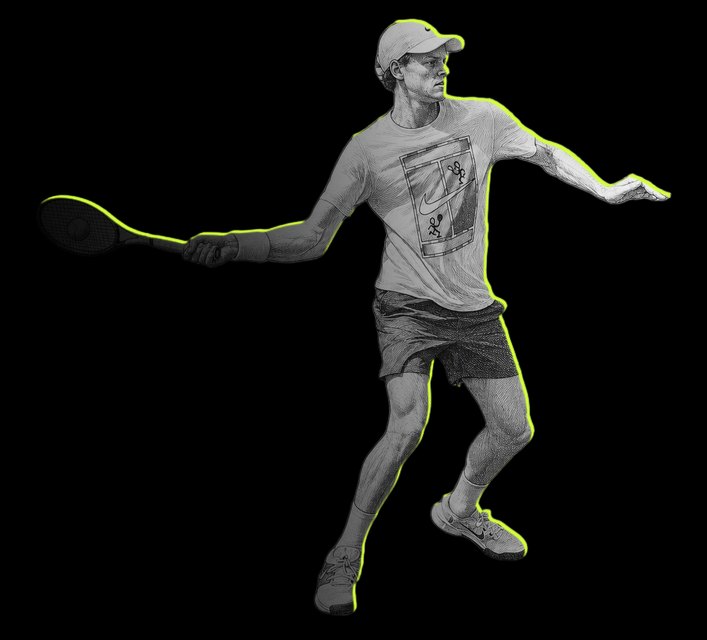
The forehand
The biggest weapon in the modern game, from unit turn to follow-through — the shot Nadal turned into a lasso and Federer into a scalpel.
Every era of tennis is defined by a forehand. It is the shot a player builds a whole game around, the one every point is quietly engineered to free up, the weapon a career gets measured by. So here is a number that should change how you watch it. Rafael Nadal's forehand spins at an average of roughly 3,200 revolutions per minute, and at its most violent closer to 5,000. Pete Sampras — no one's idea of a soft hitter — spun his at about 1,800. In a single generation the defining forehand did not learn to hit twice as hard. It learned to spin nearly twice as fast. That is the revolution, and most of the crowd watches straight past it.
The lazy version of the story says the modern forehand is about power — bigger bodies, stiffer frames, a harder swing. The power is real, but it is not the point. Spin is the point. Those thousands of extra revolutions are what let a player swing out of their shoes and still land the ball inside the line, because topspin makes the air itself push the ball down — the mechanism of the topspin chapter. The modern forehand is not a harder shot that happens to carry spin. It is a spin-delivery system that happens to hit the ball extremely hard, and the entire motion — from the ground up — is organised around brushing up the back of the ball at the last possible instant. To see how, stop trusting the highlight reel and park a real one at the moment of contact.
That is not an animation. It is real match footage — the pose, the racquet and the ball tracked frame by frame, then dissolved into the blueprint we'll draw on for the rest of the chapter. Scrub it back to the strike and look at where the strings meet the ball: out in front of the body, the racquet face travelling up as much as forward. Every claim that follows is measured off swings exactly like this one.
Three men, one movement
Nobody invented the modern forehand in a lab. It was argued into existence on court, over two decades, by players who each found a different answer to the same question: how do you put violent spin on a ball without giving up pace or control? The three most complete answers belonged to the three men who defined the era — and the most honest way to understand the shot is to lay all three on top of each other and watch them arrive at the ball together.
But the decision that made all three possible was made a generation earlier, and it looked like a mistake at the time. Through the 1970s the textbook forehand was flat: an eastern grip, a level swing, the ball driven through rather than brushed. Then a teenaged Björn Borg started swinging violently up and over the ball with a semi-western grip on a wooden racquet, burying it with topspin that dipped inside the baseline. Purists called it ugly and predicted it would never hold up. It won eleven majors. Borg had traded a little raw pace for something the flat hitters could not answer: margin. The ball cleared the net by a metre and still came down in. The last barrier fell in 1997, when Gustavo Kuerten won Roland-Garros on stiff polyester strings that let a full, fast, upward swing bite the ball instead of launching it. Poly raised the spin ceiling, and the whole tour climbed through it. Everything the three men below do is built on those two bets — swing up, and trust the string.
Roger Federer hit the forehand like a scalpel. An eastern-leaning grip, an early, out-front contact and a relaxed, whip-like arm let him take the ball on the rise and redirect it anywhere with almost no backswing tell — disguise as a weapon. Rafael Nadal hit it like a lasso. A severe semi-western grip, an extreme low-to-high path and a finish that wraps up over his head, not across his body, let him load the heaviest topspin the tour had ever seen — the ball leaving his strings already diving. Novak Djokovic hit it like a metronome that could detonate: a compact, supremely repeatable stroke with elite separation and balance, spin and depth on demand, the fewest bad forehands in history. Three grips, three finishes, three temperaments. Park the scrub at contact below and look at where each man meets the ball.
FIG. P-2 — Three forehands on one clock: each swing time-warped so contact lands together at s=0.62, each body scaled to a common torso and pinned at the hips. Federer (ink), Nadal (cobalt), Djokovic (periwinkle).
Time is warped so contact lands together at the same instant; each body is scaled to a common torso and pinned at the hips, and Nadal — a left-hander — is mirrored so all three swing the same way. What survives all that normalising is the thing that actually matters: three completely different-looking players converge on nearly the same shape at the ball. Racquet out in front, arm long, head still, the whole frame stacked over a driving base. The style is in the takeback and the finish. The mechanism is identical, and it is the one you already met a chapter ago.
The kinetic chain, laid on its side
A serve is the kinetic chain standing tall and throwing upward. The forehand is that same chain rotated flat and swung around the spine. The power still starts at the ground: you push the court, it pushes back, and that ground reaction force becomes rotation at the hips. The hips begin to open toward the net while the shoulders still hang back — the separation angle, a coil loaded like a spring — and when the trunk finally uncoils it does so on top of the speed the hips already gave it. Big slow links first, small fast links last. Nothing here is new. It has just been turned on its side.
What is particular to the forehand is where all that speed gets spent, and the six instants it passes through on the way. Below is one real tracked forehand, frozen at each of them.
Coil complete
Head falls below the hand
Head trails farthest back
Out front · 34 m/s
Driving through the line
Windshield-wiper wrap
Read it left to right. The unit turn is the whole upper body coiling as one piece — shoulders, hips and racquet turning together, the off hand cradling the throat so the arm can't cheat and start early. Then the racquet drop: the head falls below the hand, setting up an upward path to the ball. The lag is the moment the head trails farthest behind the hand as the body fires forward — the last elastic link loading, storing energy a heartbeat before it releases. Contact comes out in front, the racquet at its peak speed of about 34 metres per second exactly when it meets the ball. Then extension through the line, and finally the windshield-wiper finish, the forearm rolling the racquet up and over as the chain safely decelerates.
The grip is the whole argument
If one decision separates Federer's forehand from Nadal's, it is the bevel under the base knuckle of the hitting hand. It looks like a detail. It is the entire strategy of the shot, chosen before the ball is even tossed for the serve.
Slide that knuckle from bevel 3 (eastern) to bevel 5 (western) and the racquet face closes, the natural contact point climbs higher and moves further out front, and the swing starts wanting to travel up the back of the ball rather than through it. That is why the grip and the spin are the same choice. The eastern grip of a classic flat driver meets the ball lower and flatter; the semi-western grip most of the tour now uses meets it higher and brushes up; the full western grip of an extreme topspin game meets it higher still. More western, more topspin — and a higher, more comfortable strike zone for the shoulder-high balls the modern rally is full of.
Why out front, and why up
Two things decide whether a forehand is a weapon or a liability, and neither is how hard you swing. The first is where you meet the ball.
Contact out in front is not a stylistic flourish; it is a mechanical necessity. The racquet reaches its peak speed at the end of the chain and immediately begins to slow, so the ball has to be met while the head is still accelerating — and that point sits ahead of the front foot, out toward the net. Meet the ball late, beside or behind the hip, and you are striking with a racquet that has already fired and started to decay: less speed, less control, and no room left to brush upward. Every good forehand you have ever admired was taken early. It only looked unhurried because the player had turned in time to make it so.
The second thing is the shape of the swing. Topspin is not a wrist trick applied at the instant of contact — that is the single most common way club players fake it, and it fails because it is unrepeatable and it kills the strike. Real topspin is geometry.
The racquet head arrives at the ball travelling up as much as forward, brushes the back of it, and keeps climbing into the wiper finish. The upward path plus the string-bed's snapback is what spins the ball — thousands of revolutions a minute, all of it a consequence of the swing's shape, none of it forced by the hand. The tracked forehand on this page carries about 2,800 rpm of topspin and leaves the strings near 175 km/h. Sit that between Federer's roughly 2,500 and Nadal's 3,200 and you have the whole modern range in three numbers — and the difference between them is almost entirely the steepness of this one curve.
It matters that the wrist stays quiet through all of this. The lag you saw a figure ago — the racquet head trailing far behind the hand — is not a wrist cocked to be flicked; it is the arm and wrist relaxed enough to let the racquet fall behind the body and load like the last link of a whip. Coaches call the feeling of that drop “patting the dog.” Fire the wrist deliberately and you spend that stored energy early, before the body has finished delivering its speed, and the shot arrives soft and sprayed. Leave the wrist alone and the release happens on its own, at the bottom of the drop, exactly when the chain hands off. The best forehands in the world are, at the wrist, the most passive.
Put the two together — contact out front, a swing that climbs — and the phrase “effortless power” stops being a paradox. The player who looks relaxed and hits a ball that sounds like a gunshot is not stronger than you. They have simply organised five links to hand off in order and pointed the last one up. Spin bought them the margin to swing freely; the chain gave them the speed for free. That combination — heavy and safe at the same time — is what made the forehand the shot that runs the modern game.
And it did reorganise the game, tactically, around itself. Once the forehand could be swung at full speed with topspin holding it in, it stopped being one of two even wings and became the wing you built points to reach. A right-hander learned to run around the backhand corner to rip a forehand cross-court or inside-out into the opponent's weaker side — the single most common winning pattern in the men's game. The serve stopped being an end in itself and became a setup: hit a spot, drag a floated return, step in and end it with the next forehand. Roughly seven of every ten points end in four shots or fewer, and a disproportionate share of those four-shot points are won by whoever gets their forehand onto the ball first. The shot did not just get better. It bent the whole geometry of the point toward the side of the court it lives on.
On court
Turn before you think you need to, meet the ball out in front of your front foot, and let the racquet climb — low to high, finishing over your shoulder.
You do not groove a modern forehand by swinging harder. You groove it by fixing three things in order: the turn, the strike point, and the shape. Three drills, each training one of them:
Catch & turn builds the unit turn: rest the non-dominant hand on the racquet throat and turn your shoulders as a single block, so the coil — not the arm — starts the stroke. The low-to-high brush grooves the shape: drop the racquet head below the ball and brush up the back of it, finishing high, until spin feels like a path rather than a flick. And meet it out front fixes the strike point directly: drop a cone a stride ahead of your front foot and make yourself contact the ball level with it, never behind it.
Faults & fixes
| The fault | Why (the mechanism) | The fix |
|---|---|---|
| Late contact | Meeting the ball beside or behind the hip catches the racquet after its peak — the chain has already fired and begun to slow. | Turn and split earlier; put a cone ahead of the front foot and strike level with it. Contact belongs out front (FIG. 05-3). |
| Arming it | A square body with no unit turn leaves nothing to release — no separation, no lag, so the arm supplies all the speed from a standstill. | Coil the shoulders and hips as one unit, off-hand leading the turn, before the racquet ever goes forward. |
| Rolling the wrist | Flipping the wrist over to “make” topspin at impact kills the string-bed brush and sprays contact — the spin is never repeatable. | Keep the wrist quiet through contact; let the low-to-high path and the grip write the spin. The wiper happens after the ball, not on it. |
| A flat, level swing | Swinging level or high-to-low puts no upward brush on the ball, so there is no topspin — and no margin to swing out and still land it. | Start the racquet head below the ball and brush up the back; finish high, over the shoulder (FIG. 05-4). |
| A collapsing finish | A short, blocked follow-through can't decelerate the arm, capping racquet-head speed and dumping the shock into the elbow and wrist. | Let the windshield-wiper run its full length and catch the racquet at the opposite shoulder. |
| The wrong grip for the ball | Too continental or eastern for a high, heavy topspin ball forces contact too low, with no face angle to brush up — the topspin ceiling is capped before the swing starts. | Move the base knuckle toward semi-western (bevel 4) to meet the ball higher and out front (FIG. 05-2). |
The shot that swallowed the game
There is a reason the forehand, of all the strokes, became the one careers are built on. It is the shot where a right-hander can run around the backhand and take over the point; the shot a serve is designed to set up; the first place a young player's talent shows. But the deeper reason is the one this chapter has been circling. The forehand is where the two great forces of modern tennis — the kinetic chain and topspin — meet on the same swing. The chain gives it speed the arm could never make alone. The spin gives it the margin to use that speed without fear. Nobody had to choose between power and control any longer. The modern forehand handed them both, on the same ball.
Which is why, when you next watch Alcaraz or Sinner unload one, the thing to notice is not how hard they swing. It is how early they turn, how far in front they take it, and how high the racquet finishes — the same three things a beginner is drilling with a cone on a public court. The forehand of the greatest players who ever lived and the forehand you are learning this week are not different shots. They are the same solved problem, hit with different amounts of nerve. Next, the harder wing to trust: the backhand.
Sources & further reading
Elliott B., “Biomechanics and tennis,” British Journal of Sports Medicine (2006) — the kinetic-chain reference underneath every groundstroke · Reid M., Whiteside D. & Elliott B., “Contributions of joint rotations to racquet speed,” Journal of Sports Sciences (2006) · Elliott, Reid & Crespo, Tennis Science(ITF) — grip, contact point and swing-path mechanics · spin measurements after J. Yandell / Tennis Warehouse University high-speed video (Nadal ≈3,200 rpm, peaks ≈5,000; Federer ≈2,500; Sampras/Agassi ≈1,800), as widely reported.
The dissolve and the trio are built from real match footage (US Open practice), pose + racquet + ball tracked frame by frame; Nadal is drawn left-handed as he plays, and the trio is time-warped so all three reach contact together. The checkpoint strip, the contact plate and the swing-path trace are drawn from one motion-captured forehand (racquet-head peak ≈34 m/s, ball ≈175 km/h, ≈2,800 rpm, contact at frame 65 of 120). Single tracked swings — illustrative of the mechanism, not population averages.