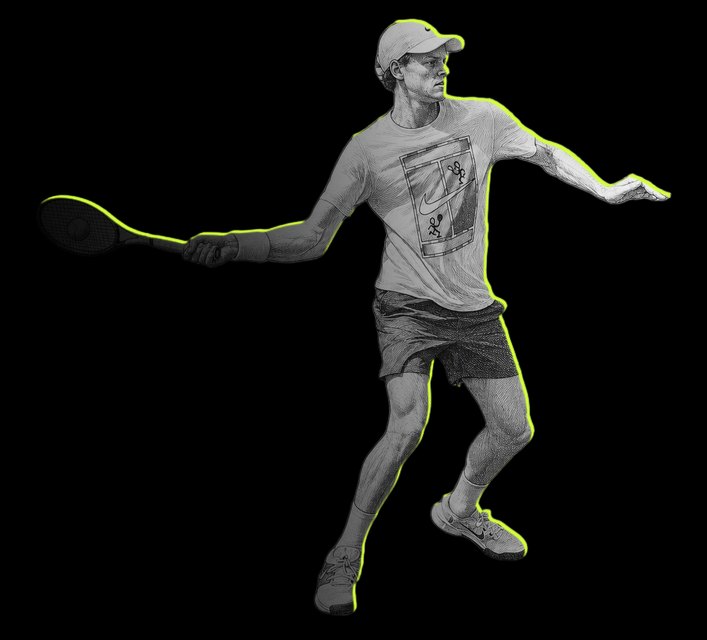
Where power comes from — the kinetic chain
Power isn't in the arm. It's a wave that starts at the ground and accelerates through every joint, each link faster than the last — the mechanism behind every big forehand you've ever admired.
Ask a room full of players where the power in a forehand comes from and almost every hand points to the same place: the arm. It is the obvious answer. The arm is the part that moves fastest, and it is the part holding the racquet. It is also wrong — and the distance between that instinct and what actually happens is the single most important idea in the sport.
Here is the number that should end the argument. On a serve, the biggest single contributor to racquet-head speed is the internal rotation of the shoulder — roughly 40% of the speed the racquet carries into the ball, in Bruce Elliott's measurements. Not the wrist. Not the forearm. A rotation deep in the shoulder that most players cannot consciously feel. And it only works — this is the part that matters — because everything below it fired first. On that same serve the legs supply an estimated 50% or more of the stroke's kinetic energy. The arm you were about to credit is the last and smallest borrower in a chain that begins at the ground. Power in tennis is not produced anywhere. It is relayed.
We call that relay the kinetic chain, and once you can see it, the whole game reorganises around it. Every “just hit it harder” cue dissolves into a sequencing problem. Every weak shot becomes a diagnosable leak you can locate on a specific link. This is the lens for everything that follows in this book — so before another word, let us take one real, tracked swing and pull the wave apart.
00 · The whole wave
Watch it once, all the way through
One real tracked forehand. At the instant it meets the ball the racquet tip is travelling thirty-four metres a second — seventy-six miles an hour of pure tip speed, faster than any muscle in the arm can move. It did not get there by swinging harder. It got there by relay. Scroll, and we'll take the wave apart one link at a time.
01 · Link 1 · Legs
It starts in the ground
You cannot push the ball — it's gone in four milliseconds. What you can push is the court, and by Newton's third law the court shoves back just as hard. That ground reaction force is the entire budget the chain gets to spend. The legs move slowly — a few metres a second — because they're the big, strong, patient link. Everything upstream is borrowing from them.
02 · Link 2 · Hips
The pelvis opens first
Ground force turns into rotation here. The hips fire before the shoulders, and for a heartbeat the two are twisting against each other — the separation angle, the trunk loading like a wound spring. Watch the hip trace arc open. The centre of the pelvis still barely moves; a proximal link is supposed to be slow. Its job isn't speed. Its job is to hand a bigger number to the next link.
03 · Link 3 · Torso
The coil releases
Now the wound spring unwinds. The trunk uncoils on top of the rotating hips, and because it starts from the speed the hips already gave it, its shoulder travels faster than the hip did. This is the summation of speed made visible: each link doesn't start from zero — it starts from wherever the last link left off, and adds its own.
04 · Link 4 · Arm
The arm lags, then whips
Here is the move every coach freezes and no one can teach: the arm is left behind. As the trunk fires forward the relaxed arm trails, stretching — and then it's slung through, the hand now moving at double the shoulder's speed. Lag isn't a wrist flick. It's stored elastic energy, released in order, downstream of everything below it.
05 · Link 5 · Wrist + racquet
The racquet is last, and fastest
The final, lightest link inherits every metre-per-second the four below it built, and adds the longest lever in the body — the racquet itself. The tip spikes to thirty-four metres a second at the exact frame it meets the ball, then immediately sheds speed. Look at the chart: the last curve towers over the other four. That is the whole point of the chain.
06 · The payoff
The wave, at last
Now watch it run. Legs, hips, torso, arm, racquet — each link lighting as its moment passes, each faster and later than the one before, the speed rolling up the body and cracking at the tip like the end of a whip. This is “effortless power.” It was never effortless. It was just relayed, in perfect order, from the ground up.
The people who proved it
The idea that speed is summed up the body, rather than made in one place, is not a coaching slogan — it is a measured fact, and someone had to measure it. For decades the Australian biomechanist Bruce Elliott pointed high-speed cameras and optical marker systems at the best servers in the world and reconstructed, joint by joint, how much each rotation contributed to the racquet at impact. His work, with Machar Reid and David Whiteside, is the reason we can say “internal rotation is worth about 40%” and mean something precise by it, rather than waving at a slow-motion replay. W. Ben Kibler mapped how the shoulder loads and unloads across the motion; Mark Kovacs and Todd Ellenbecker broke the serve into eight stages so the sequence could be taught and its failures diagnosed. The physics was always there. These are the people who made it legible.
And then there are the players whose chains are the textbook. Pete Sampras and Roger Federer built serve motions so complete — deep loading, full external rotation, an explosive release — that biomechanists still use them as the reference against which everyone else is measured. Rafael Nadal turned the forehand into an extreme rotational chain, generating a separation angle and a ground force that let a heavy topspin ball leave his racquet like it had been fired. Carlos Alcaraz and Jannik Sinner now push the same principle across every stroke: maximise the leg drive and the trunk rotation, and let the arm be the beneficiary. None of them invented the chain. They just refused to leak a single link of it.
Link one: you push the ground
You cannot push the ball; it is gone in four milliseconds, long before any muscle could react to it. What you can push is the court. Drive the feet down into the ground and, by Newton's third law, the ground drives back up through the legs with exactly as much force. That returned force — ground reaction force — is not a source of the chain's power. It is the source. Everything above it in the body is spending a budget the legs set.
This is why good coaches obsess over the legs of a shot that ends at the arm. Cut the supply at the ground — hit off a weak, falling base — and there is simply less for the chain to relay, no matter how hard the arm swings. The legs are slow and strong on purpose. They move only a few metres a second, because their job is not to be fast. Their job is to hand a large quantity of momentum to the next link up.
Link two and three: the coil that fires
Ground force becomes rotation at the hips. And here the chain does something that looks, at first, like a mistake: the hips begin to open toward the net while the shoulders still hang back. For a fraction of a second the upper body is twisting against the lower one. That gap has a name — the separation angle, the “X-factor” borrowed from golf — and it is not a mistake at all. It is a loaded spring.
The mechanism underneath it is the stretch-shortening cycle. Rapidly stretch a muscle-tendon unit under load and it does two things: it stores elastic energy like a drawn bow, and it trips a reflex that makes the following contraction more forceful than one started from rest. The coil of the trunk against the hips is a stretch-shortening engine. So is the deep external rotation of the shoulder on a serve, cocked back before it fires forward. “Load, then explode” is not a metaphor — it is a description of stored energy being released on a spring.
When the trunk finally uncoils, it does so on top of the speed the hips already gave it. The shoulder inherits the trunk's speed and adds its own. This is the heart of the whole idea, the summation of speed: each segment does not start from zero. It starts from wherever the previous link left off, accelerates, reaches its own peak — and then, crucially, decelerates, throwing its momentum into the next, lighter, faster segment. Big slow links first, small fast links last. It is exactly how a bullwhip turns a lazy movement of the handle into a supersonic crack at the tip.
Link four and five: the lag and the crack
The most copied and least understood moment in tennis lives here. Watch a professional forehand in slow motion and the racquet appears to be left behind — the head trailing far behind the hand as the body rotates forward. That lag is not laziness and it is not a wrist flick waiting to happen. It is the last elastic link in the chain: a relaxed arm and wrist letting the racquet trail and load while the trunk delivers momentum to it, storing energy a heartbeat before it fires.
Then it releases. The lightest link, carrying every metre-per-second the four below it built, whips through — and the racquet head, on the longest lever in the body, reaches its peak speed at the exact instant it meets the ball, then immediately begins to slow. In the tracked forehand you scrubbed above, the tip hits roughly 34 metres a second at contact — about 122 km/h of pure racquet-head speed — and sends the ball out near 175 km/h with some 2,800 rpm of topspin on it. Plot the speed of each link against time and you get the signature of every powerful stroke ever measured: a late, sharp spike, the racquet peaking last and highest, exactly when it counts.
What a clean chain actually buys you
“Effortless power” is the phrase commentators reach for when a player who looks relaxed hits a ball that sounds like a gunshot. The phrase is real, and now you know why it is not a paradox. The power was never effortless — it was relayed, built out of a ground push and a coil and a stretch, none of which look like effort because none of them happen in the arm you were watching. A well-sequenced chain lets a smaller player out-hit a bigger one, because the ceiling on a tennis shot is not set by how hard one muscle can pull. It is set by how cleanly five links hand off in order.
Which means the failures are just as precise as the successes. Every weak or wild shot is an energy leak — a point where the sequence is mistimed, skipped, or thrown out of order, bleeding speed before it ever reaches the strings. The player who “arms” the ball has skipped the legs and trunk and asked the smallest link to do the biggest job. The player who fires the arm early has spent the distal links before the proximal ones peaked, so there is nothing left to inherit. Poor separation leaves the trunk's free power untapped. And a stiff, blocked follow-through cannot brake the proximal links — which means they never decelerated, which means the tip never got its final acceleration, and the joints absorbed the shock instead. Every one of these is diagnosable. Every one of these is fixable. That is the gift of seeing the chain: your errors stop being mysteries and start being addresses.
On court
Feel the racquet head fall behind you before it ever goes forward — and let it be the last thing to arrive, and the fastest.
You do not build a chain by swinging harder; you build it by sequencing. Three drills, in the order coaches teach them, each training a different link of the relay:
The medicine-ball rotational throw trains the whole sequence and the stretch-shortening cycle at once: load the hips, fire from the ground up, and release the ball across your body — you physically cannot throw it far by arming it. The shadow stroke, swung slowly and counted out loud — legs, hips, torso, arm, racquet — grooves the order before speed can hide a mistake. And band-resisted rotations teach separation directly: open the hips against the band while the shoulders hold, then release, until the coil-and-fire feels like a spring rather than a shove.
Faults & fixes
| The fault | Why (the mechanism) | The fix |
|---|---|---|
| Arming the ball | The legs and trunk never fire; the arm supplies all the speed from a standing base. | Exaggerate the leg drive and unit turn. Hit balls from a deep knee bend until the ground feels like the start of the swing. |
| Early arm firing | The distal links fire before the proximal ones have peaked, so there is no momentum to inherit. | Rhythm and shadow-stroke drills, counting the sequence out loud: legs, hips, torso, arm, racquet. |
| Poor separation | Hips and shoulders rotate as one block, so the trunk never pre-stretches — the free power is left on the table. | Band-resisted rotations; feel the hips open while the shoulders hold, then release. |
| Off-balance base | A weak or falling stance can't push the court, so ground reaction force — the whole budget — starts small. | Footwork and stance work: land balanced, load evenly, keep the base under the shot. |
| Blocked deceleration | A short, stiff follow-through can't brake the proximal links, capping distal speed and loading the joints. | Let the finish run its full length. The chain has to decelerate safely for the tip to have accelerated. |
Every stroke is this chain in a costume
Here is the quiet secret of the rest of this book. Nothing you are about to read is really a new stroke. The serve is the kinetic chain standing tall and throwing vertically — leg drive to shoulder rotation to the racquet flung up at the ball. The forehand is the same chain turned on its side and made rotational, hips and trunk driving a horizontal whip. The two-handed backhand is a more compact version with a second arm helping to rotate. The volley is the chain deliberately truncated, most of the whip left out on purpose because you want a firm block, not a crack. Different costumes. Same body. Same wave, starting at the ground.
So when we get to the serve and the forehand in the chapters ahead and start measuring internal rotation and lag and separation in detail, none of it will be new machinery. It will be this one mechanism, dressed for a different shot. Learn the chain once and you have not learned a stroke. You have learned the engine underneath all of them — and every time you see a player hit a ball that looks impossibly easy and lands impossibly hard, you will know exactly where to look. Not the arm. The ground.
Sources & further reading
Elliott B., “Biomechanics and tennis,” British Journal of Sports Medicine (2006) — the canonical kinetic-chain reference; internal rotation ≈40% of serve racquet speed · Kovacs M. & Ellenbecker T., “An 8-Stage Model for Evaluating the Tennis Serve,” Sports Health (2011) · Kibler W. B., “Biomechanical analysis of the shoulder during tennis activities,” Clinics in Sports Medicine (1995) · Reid M., Whiteside D. & Elliott B., “Contributions of joint rotations to racquet speed in the tennis serve,” Journal of Sports Sciences (2006) · Elliott, Reid & Crespo, Tennis Science (ITF).
The Wave and its speed chart are rendered from one real motion-captured forehand (racquet-head peak ≈34 m/s, ball ≈175 km/h, ≈2,800 rpm). It is a single tracked swing — illustrative of the mechanism, not a population average. The per-link velocities are the measured linear speeds of each joint; the proximal links move slowly by design, the racquet fastest of all.